
The three roads to Tulum beach, and which to take after dark
Tulum town and Tulum beach are two different places, and only three roads connect them. That is the whole network. Whatever app you are using will offer you one of the three and tell you they are much the same, and they are not — the difference between them is lighting, and lighting is the entire story once the sun goes down.
Here is what each one is actually like, from people who ride them every day.
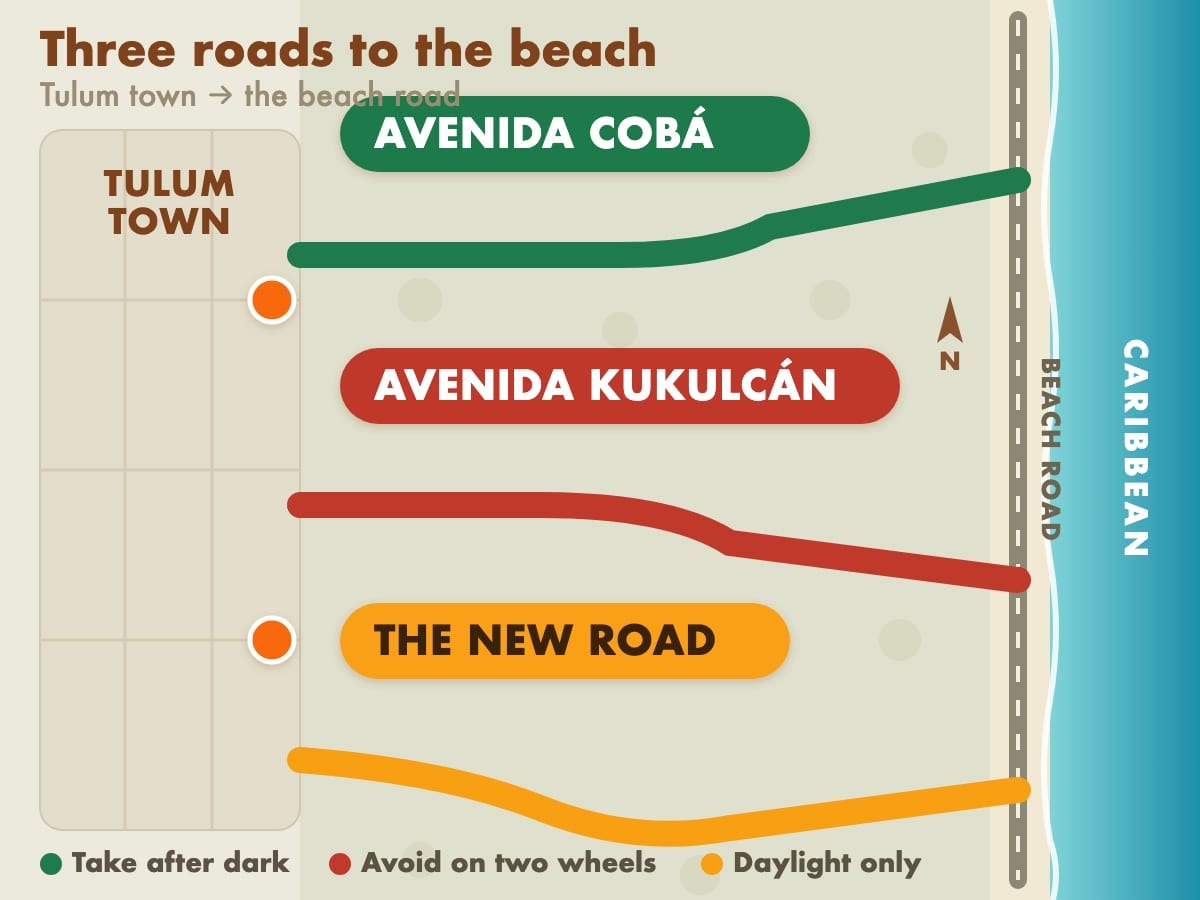
| Road | In daylight | After dark |
|---|---|---|
| Avenida Cobá | The best. Bike path, and the busiest in a good way | The one to take. Street lighting the whole way |
| Avenida Kukulcán | Fine in a car. Not advisable on two wheels | Avoid. No lighting, fast traffic, no room |
| The new road | Lovely. Almost no traffic | Avoid. Unlit and empty |
Avenida Cobá — take this one
If you only remember one thing from this page, remember this road. Avenida Cobá has street lighting along it and a dedicated bike path, which makes it the only one of the three that is genuinely set up for someone on a bicycle, an e-bike or a scooter.
It is also the busiest, and that is a feature rather than a problem. Traffic means lights, means other people, means that if your chain comes off or a tyre goes down at eleven at night you are not standing alone in the dark. On a route like this, company is a safety feature.
One point of confusion worth clearing up, because it catches people constantly: Avenida Cobá and "the Cobá road" are not the same thing. Avenida Cobá runs east through town towards the beach. The Cobá road is the highway heading the other way, west, out to the cenotes and the ruins at Cobá. Same name, opposite directions. If an app or a local tells you "Cobá," work out which one they mean before you set off.
Avenida Kukulcán — the one we tell people not to ride
This is the road we actively advise against, and it is worth being blunt about why.
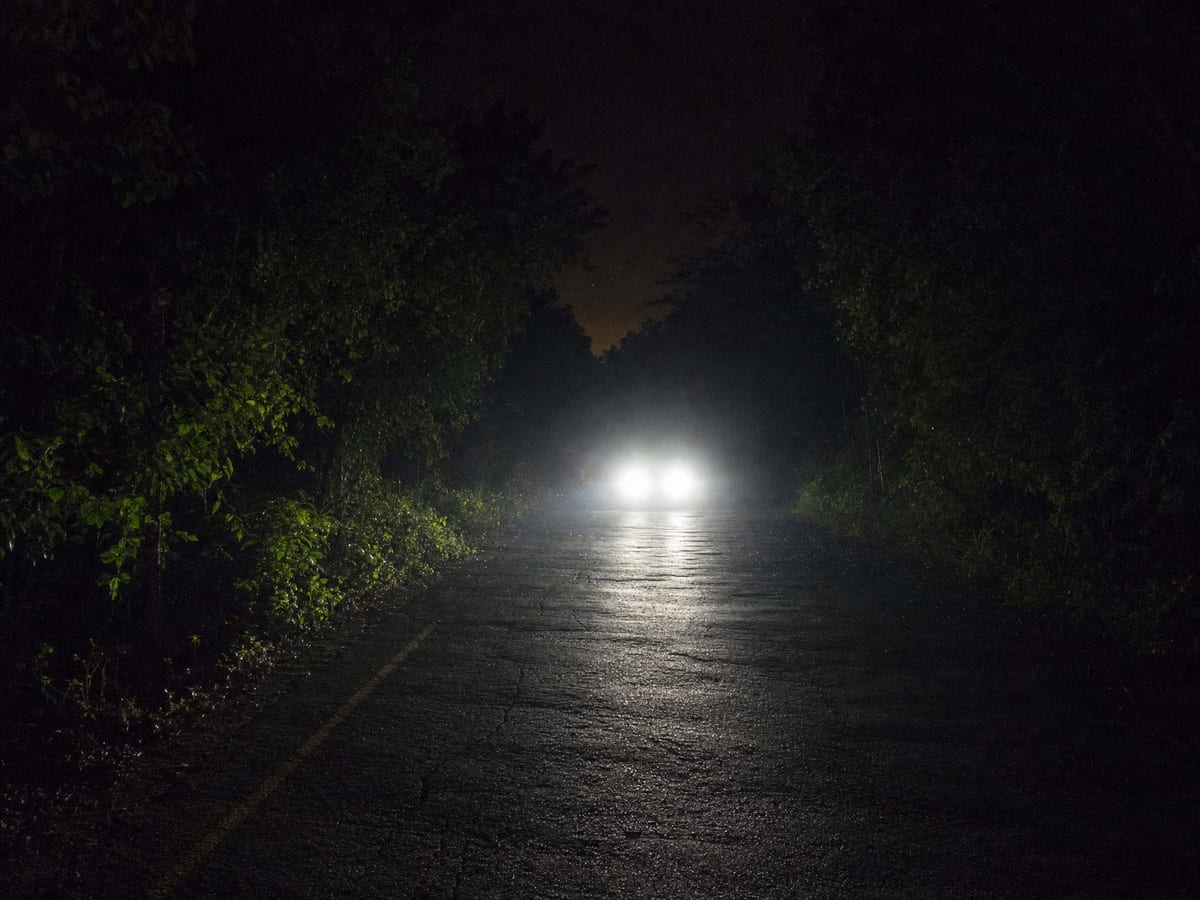
It is a thin dual-lane road with no street lighting at all, and the traffic on it moves very fast — faster than anything else around town, because the road invites it. There is no bike path, and not much shoulder to be pushed onto either. In daylight, in a car, it is unremarkable. On a bicycle or a scooter it is the most exposed road of the three.
At night it gets worse for a reason that has nothing to do with the road itself. The late traffic coming back from the beach is not all sober. People who have been at a beach club since the afternoon are driving back into town along an unlit road at speed, and a cyclist in dark clothes with no lights is effectively invisible to them until it is far too late.
You do not have to take our word for the maths. On an unlit road, a driver's headlights give them a fixed amount of warning, and the faster they are going the less of that warning converts into time. Add alcohol and you are relying on someone whose reactions are already slower seeing you sooner. It is not a risk worth taking to save a few minutes.
If you are in a taxi or a car, Kukulcán is a perfectly normal road. On two wheels, at night, it is the one to leave alone.
The third road — brilliant in the day, not after dark
There is a third connection, and most people never find it because it is new enough that it barely shows up on any map. Your navigation app will probably not offer it, which is exactly why it is so quiet.
In daylight it is the nicest ride of the three. Almost no traffic, no queue of taxis and water trucks, and none of the stop-start that the main routes collect at the busy hours. If you are heading to the beach in the morning and you know where it starts, take it.
At night, the same quality turns against it. It is unlit, and it is empty — and empty means that if something goes wrong there is nobody passing. That is a different kind of risk from Kukulcán's, and it is still a reason to be somewhere else after dark.
Ask us at the counter and we will show you where it begins. It is one of those pieces of local knowledge that is genuinely useful and almost impossible to find online.
So: the night rule
It is one sentence. After dark, come back along Avenida Cobá. It is lit, it has a bike path, and there are people on it. The extra few minutes are the cheapest insurance you will buy on this trip.
Three things that go with it:
- Be visible. Lights on, front and back, every time — on a scooter that means the headlight on even when the road looks lit. Wear something light-coloured rather than the black everyone packs for Tulum.
- If you are going to be out after dark, say so when you collect the vehicle. We would far rather sort that out at the counter than have you discover the problem at the top of an unlit road.
- Helmets are not optional on a scooter, for the rider and the passenger — that is the law here, and an unlit road at night is exactly the scenario it exists for.
And when you get to the beach road itself
All three of these feed onto one single-lane road running the length of the beach, and that road is the real bottleneck in Tulum. Water trucks stop to deliver to hotels. Taxis pull over wherever someone wants to get out. There are very few places to turn around. We have sat in that traffic for three hours trying to get to a dinner reservation.
This is the argument for two wheels in one paragraph, and it is not a sales pitch — it is just what the road is. A bicycle or a scooter goes past the queue; a car joins it. More cars arriving is going to make this worse before it gets better, which is worth knowing if you are deciding how to get around for the week.
What we tell people at the counter
Going out in the morning, take whichever you like — all three are fine in daylight, and the new one is the pleasant one.
Coming back after dark, Avenida Cobá, every time, lights on.
That is the whole of it. If you want the rest of what these roads will throw at you — the topes you cannot see, the potholes that vanish under a headlight, and the streets with no signs at all — we have written that up separately.
Questions people ask
- How many roads connect Tulum town to the beach?
- Three. That is the entire network, which is why the beach road congests the way it does — and it is also why which one you choose matters more here than it would in a bigger town.
- Which road should I take back from Tulum beach at night?
- Avenida Cobá. It is the only one of the three with street lighting along it and a dedicated bike path, and it is the busiest, which means there are other people around if anything goes wrong. The few extra minutes are worth it.
- Is Avenida Kukulcán safe to cycle on?
- Not on two wheels, and especially not at night. It is a thin dual-lane road with no street lighting at all, no bike path and very little shoulder, and traffic moves fast along it. After dark the late traffic coming back from the beach clubs is not all sober, and an unlit cyclist in dark clothes is effectively invisible on an unlit road. In a car it is unremarkable; on a bicycle or scooter it is the most exposed of the three.
- Is Avenida Cobá the same as the road to the Cobá ruins?
- No, and this catches people out constantly. Avenida Cobá runs east through town towards the beach. The Cobá road is the highway heading west, out to the cenotes and the ruins at Cobá. Same name, opposite directions — check which one is meant before you set off.
- What is the third road to Tulum beach?
- It is a newer connection that barely appears on most maps, so navigation apps generally do not offer it. That is why it is so quiet: in daylight it is the nicest of the three to ride, with almost no traffic. At night it is unlit and empty, so it is not the one to come home on. Ask at the shop and we will show you where it starts.
- Why is the Tulum beach road always so congested?
- Because three roads feed onto one single lane running the length of the beach, with water trucks stopping to deliver to hotels, taxis pulling over to drop people off, and very few places to turn around. It is routine to lose hours to it in a car at the busy times, which is the single best argument for getting around on two wheels here.
- Do I need lights to ride at night in Tulum?
- Yes, front and back, and on a scooter the headlight on even where the road looks lit. Light-coloured clothing helps more than people expect on roads with no street lighting. If you know you will be out after dark, mention it when you pick the vehicle up.