
Uber Is in Tulum Now — What It Actually Changes
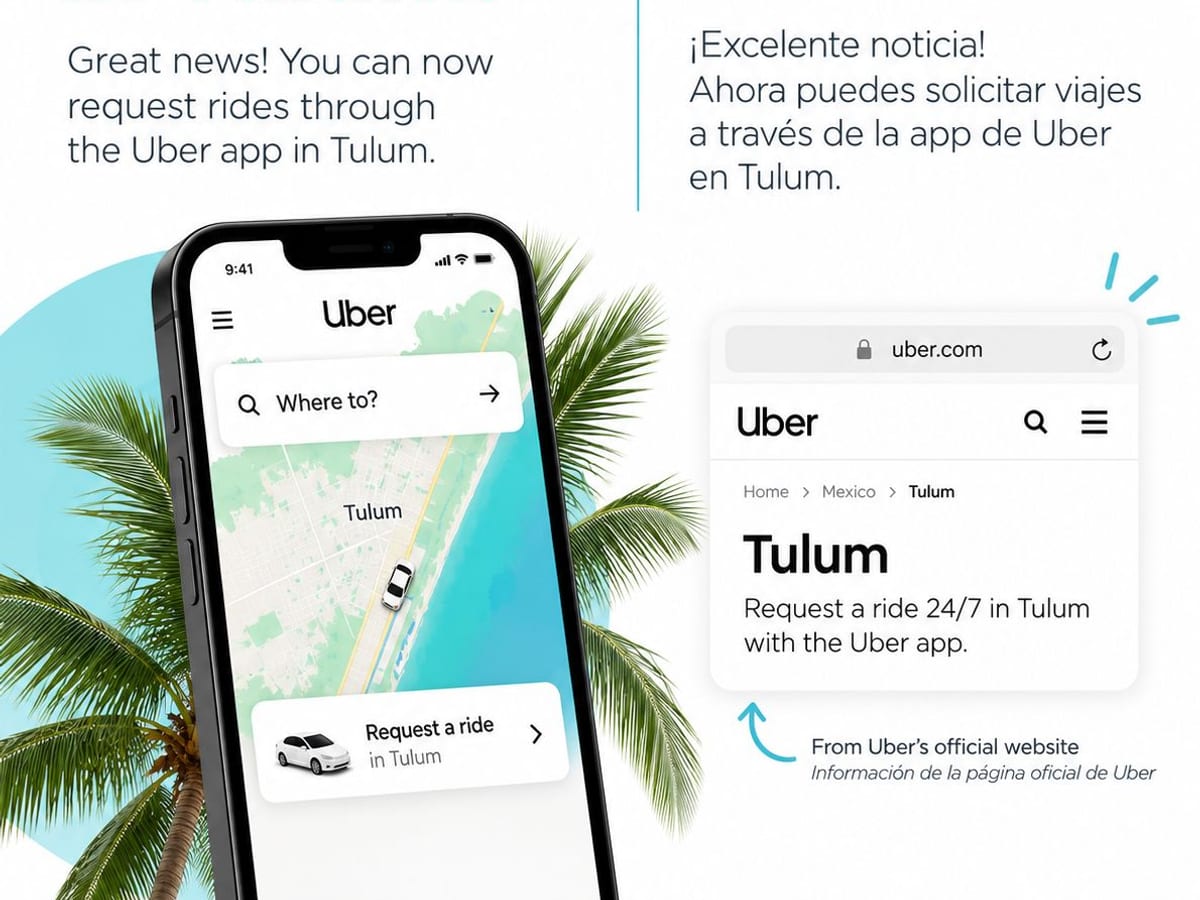
Uber is now operating in Tulum. It is on Uber’s own site — there is a Tulum city page taking ride requests and driver sign-ups — and you can open the app here and get a car.
That is good news, and we are going to say so even though we rent the alternative. Then we are going to say the part that is not on anybody’s announcement graphic.
Why it is genuinely good news
The worst thing about getting around Tulum has always been the price conversation. No meters, no published tariff, a fare agreed through a car window — and a number that moves with the season, the hour, and how much like a tourist you look.
An app that shows you the price before you get in removes all of that. Not because drivers were dishonest, but because a stranger negotiating in a second language at eleven at night was never a fair fight. If you need a car, this is simply a better way to get one.
What “Uber” actually means here
Worth knowing, because it is not quite the Uber you have at home. Across Quintana Roo, Uber did not arrive by competing with the taxi sector — it arrived largely by bringing licensed taxi drivers onto the platform. In Cancún that was more than two thousand of them.
So the car that turns up is often a local taxi, dispatched through an app, with the price shown up front. The driver is frequently the same person who would have been on the corner anyway. What changed is the pricing, not the fleet.
It also means the long-running friction between the platforms and the taxi unions here has not entirely gone away, and availability can be patchy — particularly late at night.
Now the part that is not in the announcement
Tulum’s roads cannot absorb more cars. That is not a complaint about change. It is a description of the geometry.
There are only three roads that reach the beach road. Three. Every hotel guest, every dinner booking, every beach club, every delivery and every taxi funnels through those three connections.
And the beach road itself is one lane in each direction, with no hard shoulder and almost nowhere to turn around. So it takes exactly one stationary vehicle to stop the whole thing:
- Water trucks delivering to the hotels. They have to stop, there is nowhere else for them to be, and while they are stopped nothing moves.
- Taxis pulling over to collect or drop someone off, which happens constantly along the entire length of it.
- Anyone attempting to turn around, because there are so few places to do it.
Add cars and you do not add capacity. You add more things that stop.
Three hours to get to dinner
We are not speculating. We have sat in that traffic for more than three hours trying to reach a restaurant on the beach road, and again trying to reach an event. Not in a freak storm — on a normal busy evening.
That is the thing visitors never price in. A fare that is fair is still a fare for a journey that takes three hours. Fair pricing does not make a jammed single-lane road move.
So what should you actually do?
Honestly, both. Here is how we would split it.
Take a car when you are coming from the airport, you have luggage, it is pouring with rain, you are in a group, it is very late, or you have been drinking. We would always rather you took a car than rode home from a beach club.
Take two wheels when you are heading to the beach road at a busy hour, going to a cenote, booked somewhere at a time you care about, or you simply want the day to belong to you rather than to somebody else’s schedule.
A bicycle or a scooter does not sit in the queue. It passes the water truck. It parks where a car cannot. On the beach road at seven in the evening, two wheels is not the cheap option — it is the fast one. If you are deciding between them, we wrote an honest comparison.
Let us hope they do something about it
More options for visitors is a good thing and we will not pretend otherwise. But the roads were already at their limit before this, and nothing about another app adds a lane, a turning point, or a loading bay for the water trucks.
What would actually help: somewhere for delivery vehicles to stop, proper pick-up and drop-off points instead of pulling over wherever, and more than three ways to reach the beach. Let us hope it comes.
Until it does, the advice from a shop that rents bicycles and scooters is the same as it has always been: work out how you are going to move before you arrive, and do not assume a car is the fast way to the beach. It usually is not.
Questions people ask
- Is Uber really available in Tulum now?
- Yes, and it is recent. Uber lists Tulum on its own website and you can request a ride in the app. Availability can still be patchy late at night.
- Is Uber cheaper than a taxi in Tulum?
- Often, but the bigger change is that the price is shown before you get in rather than negotiated through a window. Across Quintana Roo many Uber drivers are licensed taxi drivers on the platform, so it is less a different service than it first appears.
- Will Uber make traffic on the beach road worse?
- More cars on a road with one lane each way, three entry points and almost nowhere to turn around does not create capacity. Fair pricing does not make a jammed road move.
- What is the fastest way to the beach road in the evening?
- A bicycle or a scooter. They do not queue behind the water truck, they pass the taxi that has pulled over, and they park where a car cannot.