
Tulum Beach Today: live camera, sargassum map and how to read them
This page is live, whatever date you see above. The camera and the sargassum map below update themselves — the date is just when we first wrote the guidance around them.
This is the question we get more than any other in the week before someone flies: what does the beach actually look like right now?
Nobody can answer that in advance, because it changes daily and sometimes within a morning. What you can do is look for yourself. Below is a live camera on the Tulum beach road, and underneath it, how to read what you are seeing — because a brown line on a screen does not always mean what people think it means.
The live camera
Casa Malca — Km 9.5
Live stream by Beach Live Cams, looking out over the sand at Casa Malca. Also shown on Casa Malca's own beach page. If the picture is black, it is night in Tulum — we are on Cancún time, UTC−5, all year.
That is currently the only reliably live camera on the Tulum beach road, which is less helpful than it sounds — it shows you one hotel's sand and tells you nothing about the rest of the coast. Which is why the next section matters more than the camera does.
If you run a camera on this coast and want it listed here, tell us. More stretches of beach means a far more useful page, and we will happily credit and link you.
The sargassum traffic light — better than the camera
Quintana Roo has an official daily sargassum map. The Red de Monitoreo del Sargazo scores around 140 monitoring points along the state's coast and publishes an updated map, colour-coded beach by beach:
- Blue — no sargassum
- Green — low
- Yellow — moderate
- Orange — abundant
- Red — excessive
This is the thing to check, because it covers the beaches no camera points at. The map goes out through the monitoring network's own Facebook page and the state environment department, SEMA. If you would rather read it as a map than a social post, FEUDO publish the same SEMA data as a browsable radar in English, which is easier going.
Worth knowing honestly: 2026 has been reported as a record sargassum year across the Mexican Caribbean, with accumulation running since January. That does not mean every day or every beach — the traffic light exists precisely because it varies — but it does mean checking before you go is worth more this year than usual.
Wind — the variable underneath all of it
Sargassum does not decide to arrive; it gets pushed. An onshore easterly brings it in, a calmer or offshore spell keeps it off. If the camera looks clean and the wind has been blowing onshore for two days, be a little sceptical of the picture.
Windy is the easiest place to see wind direction for this coast, and it is free.
How to read what you are looking at
A live picture is only useful if you know what the picture is telling you.
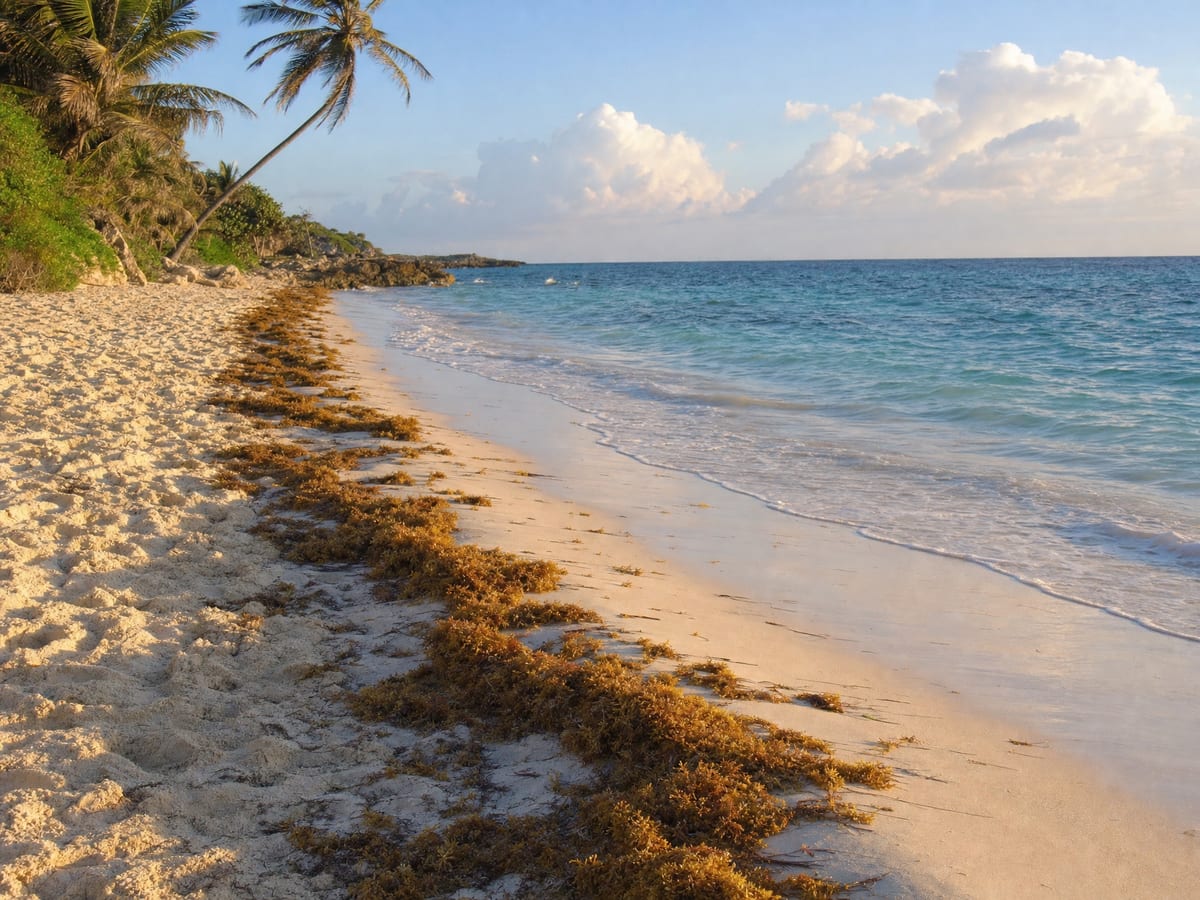
- A brown or green line at the water's edge is sargassum that has already landed. How wide that line is matters more than whether it exists — a thin strip gets cleared; a metre-deep bank does not.
- Dark patches out on the water are sargassum still offshore, drifting in. That is the useful early warning: a clean beach with brown water beyond the break often means tomorrow looks different from today.
- Check the time stamp and the time of day. Early morning shows you what drifted in overnight, before any clearing has happened. Late morning on a hotel frontage may show you a beach that has already been raked. Both are true pictures of different things.
- Wind is the thing that actually decides it. An onshore easterly pushes sargassum in; a calmer spell or an offshore breeze keeps it out. If you only check one extra number alongside the camera, check the wind direction.
- One camera is one hotel. It tells you about that stretch of sand and no further — which brings us to the part most people get wrong.
The beach is not one beach
Tulum's coast runs for kilometres, and on the same morning the north end and the far south end can look like different countries. One can be clear while the other has a bank of weed on it, depending on the wind, the currents and the shape of the reef in front of each section.
This is why a single camera, or a single bad photo on social media, sends people into a panic that the day does not deserve. If one stretch looks poor, it is genuinely worth going to look at another.
And that is a lot easier on two wheels than in a car. From our Aldea Zamá store it is roughly 20 minutes by bike or 8 by scooter to the north end of the beach road, and 40 by bike or 15 by scooter to the far south. A car does the same journey stuck in the single lane everything else is queuing in, with nowhere to park when it gets there.
Sargassum season, honestly
Sargassum is seaweed that drifts across the Atlantic and arrives on this coast in waves. It is natural, it is not pollution, and it is not a sign that anything has gone wrong.
It is generally at its worst somewhere between about April and August, and the honest caveat matters more than the dates: it varies enormously from year to year, week to week and beach to beach. There are peak-season weeks with clean water and shoulder-season days with a bank of it. Anyone who tells you with confidence what next June will look like is guessing.
Hotels and beach clubs clear their own frontage, so a paying beach is often in far better shape than the public stretch next door. That is worth knowing before you write the whole day off.
If it is in — the day is not ruined
This is the part we genuinely believe, and it is the reason we keep saying it: a seaweed week in Tulum is cenote and lagoon week, and the fresh water here is better than the sea on its best day.
Cenotes are cool, clear, completely unaffected by anything happening in the ocean, and mostly a short ride from town. The lagoons are the other answer. We have written the whole thing up — where to go when the beach has weed on it — and it is the single most useful page on this site in a bad sargassum week.
Worth saying plainly: that is also the week when having your own wheels matters most. The alternatives are all inland, and most of them are a short ride rather than a taxi fare.
What else to check the same morning
- Wind — direction more than speed, for the reason above.
- Rain — afternoon storms are normal in the wet season and usually pass. They are not a reason to cancel a morning.
- Heat — if it is going to be brutal, ride early and treat the middle of the day as cenote time rather than beach-road time.
Check the camera, check the wind, and go and look. That is the whole method, and it beats any forecast anyone can give you a week out.
Questions people ask
- What does Tulum beach look like today?
- Nobody can tell you in advance — it changes daily and sometimes within a morning. The live cameras on this page are the fastest way to see for yourself. Look at how wide the line of seaweed at the water's edge is rather than whether there is one, check for dark patches still out on the water, and note the time of day, since an early-morning picture shows what drifted in overnight and a later one may show a beach that has already been cleared.
- Is there seaweed on Tulum beach right now?
- Check the cameras above rather than any article's answer, including this one. Sargassum arrives in waves, is generally worst somewhere between about April and August, and varies enormously year to year, week to week and beach to beach. There are peak-season weeks with clean water and quiet-season days with a bank of it.
- Is the whole Tulum coast affected at the same time?
- No, and this is the thing most visitors get wrong. The coast runs for kilometres and the north end and the far south can look completely different on the same morning, depending on wind, current and the reef in front of each stretch. One camera shows you one hotel's sand. If one stretch looks poor it is genuinely worth riding to another.
- When is sargassum season in Tulum?
- Broadly April to August, with the worst of it usually in the middle of that window — but the variation is the real answer. It differs between years, between weeks and between beaches, so the dates are a rough guide rather than a forecast.
- What can I do in Tulum if the beach has seaweed?
- Go inland. The cenotes are cool, clear fresh water and completely unaffected by anything happening in the sea, and the lagoons are the other answer. Most are a short ride from town rather than a taxi fare, which is why a bike, e-bike or scooter matters most in exactly the weeks the beach is poor.
- Do hotels clear the seaweed in Tulum?
- Hotels and beach clubs generally clear their own frontage, so a paying beach is often in much better condition than the public stretch beside it. That is worth checking before writing off a day based on one photo.
- How can I check sargassum in Tulum before I travel?
- Quintana Roo runs an official daily sargassum map. The Red de Monitoreo del Sargazo scores around 140 monitoring points along the state coast and colour-codes each beach: blue for none, green low, yellow moderate, orange abundant and red excessive. It is published through the monitoring network's Facebook page and the state environment department, SEMA. It is more useful than any single camera because it covers the beaches nothing points at.
- Was 2026 a bad year for sargassum in Mexico?
- It has been reported as a record year across the Mexican Caribbean, with accumulation running since January. That does not mean every beach on every day — the daily traffic light exists precisely because conditions vary along the coast and through the week — but it does mean checking before you travel is worth more this year than usual.