
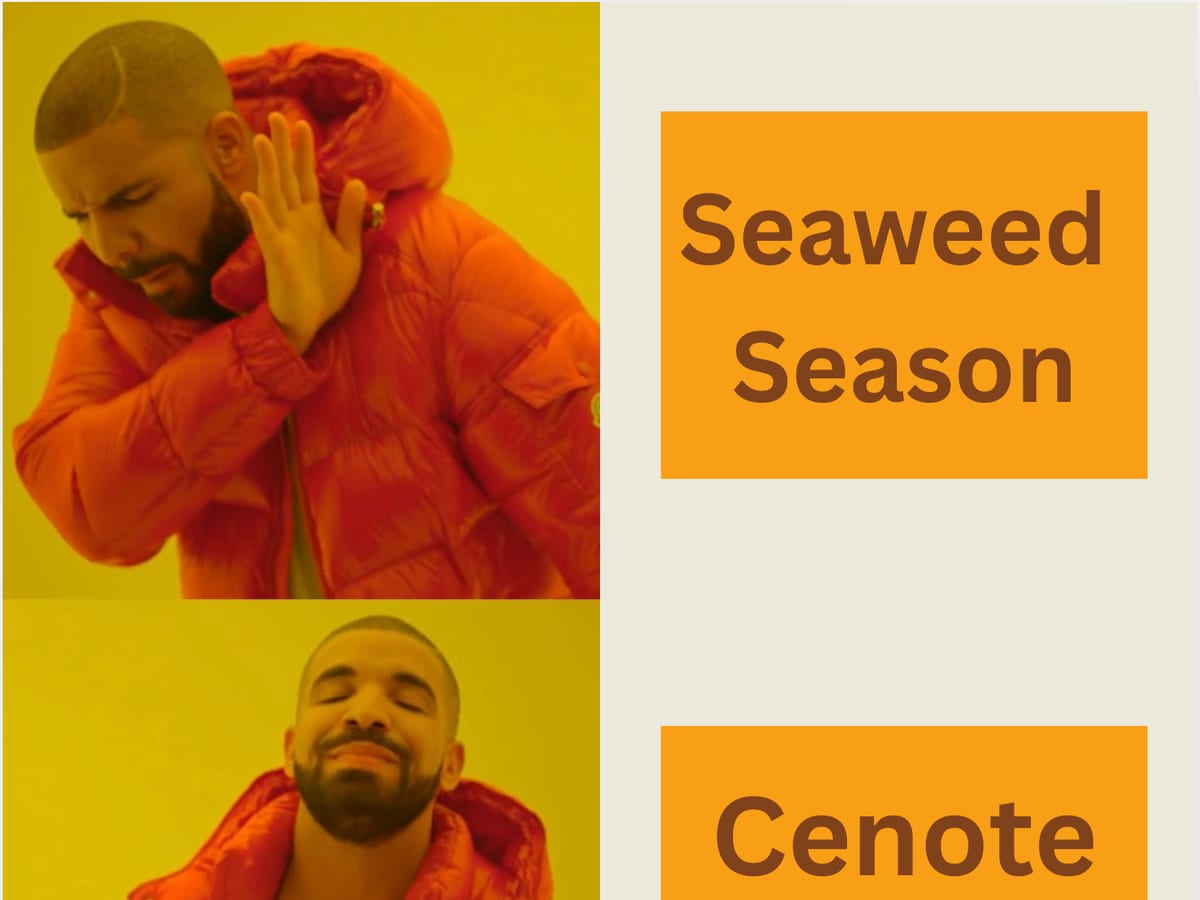
Seaweed Season in Tulum? We Call It Cenote and Lagoon Season
Every summer we have the same conversation with people who have just arrived, and a lot of them had it with themselves for weeks beforehand.
They've seen a photo of a Tulum beach buried under brown seaweed. They've read a forum thread. Some of them nearly cancelled.
So here's the honest version from people who live here — including the part that isn't flattering — and then the part nobody tells you, which is that locals genuinely look forward to this time of year.
Want to know what the beach looks like right now? Tulum Beach Today has the live camera on the beach road and the official daily sargassum map for 140 beaches.
First, the honest bit
Sargassum is a brown seaweed that drifts across the Atlantic and washes onto Caribbean-facing coastlines, broadly between May and September. It is real, it smells when it sits in the sun, and in a heavy week it can cover a beach.
What the scary photos don't show is how variable it is. It changes beach to beach along the same stretch of coast, and day to day on the same beach — clear one morning, covered the next, clear again two days later. Nobody can tell you in March what your particular week in July will look like. Anyone who does is guessing.
We rent beach cruisers. It would be easier for us to tell you the beach is always perfect. It isn't, and you'd find out.
Now the part that actually matters
Tulum sits on top of the largest underground river system on earth. The whole peninsula is limestone, and where the rock has collapsed you get a cenote — a freshwater pool fed from below, filtered through stone, and completely unaffected by anything happening out at sea.
There are thousands of them within reach of this town. The water sits around 24–25°C year-round, it's clear enough to see the fish at the bottom, and on a 34-degree August afternoon it is genuinely better swimming than the Caribbean.
That's why we don't call it seaweed season. We call it cenote and lagoon season — because the months the beach is least reliable are exactly the months the inland water is at its best, and the crowds have gone to the coast.
Vesica — cenote club in the jungle
If you want the cenote experience without roughing it, Vesica is the answer. It's an open-air cenote club set in the jungle north of town, built around natural freshwater cenotes — two of them included in a single entrance — with a proper restaurant and relaxation areas alongside.
It's the one to pick when you want somewhere to spend the whole day rather than somewhere to swim for twenty minutes and leave. Swim, eat, lie down, swim again.
Neek and Sipalitos — two clubs, one lagoon
Inland from the coast there is a freshwater lagoon — Laguna Nopalitos — with two clubs sitting side by side on it — turquoise water, jungle on every side, and no sargassum ever, because it is not the sea.
Neek is a restaurant and lagoon club, and the weekend Lagoon Sessions are what most people have heard of — live DJs, swimming, a long afternoon that runs into the evening. If you want the social version of a Tulum water day, that is the one.
Sipalitos is the lagoon club next door, on the same water — a restaurant and laguna club with wellness sessions and events alongside the swimming. It opens Thursday to Tuesday, 11am to 8pm. Worth knowing about simply because you have a choice: same lagoon, two different front doors, two different crowds.
Our advice either way — come midweek if you can. The water is identical and there is a fraction of the people.
And the cenotes themselves
Beyond the clubs, there are dozens of straightforward cenotes within a short ride — some with a ladder and a hut selling water, some developed with decks and changing rooms, some barely signposted.
The single best piece of advice: go early. The cenotes nearest town open before the tour vans arrive from Cancún and Playa, and the hour between opening and the first coach is the best hour of the day in Tulum. By eleven it's a different place.
Our guide to the best cenotes you can reach by bike, e-bike or scooter has the ones worth the trip and how far each actually is.
One rule that protects all of it
Rinse off before you get in, and don't wear sunscreen or insect repellent into a cenote — not even "reef-safe" products.
These are closed freshwater systems feeding an aquifer that the whole peninsula drinks from, and they don't flush out the way the sea does. Most cenotes will ask you to shower first. They're not being fussy.
Getting there is the whole thing
Here's the catch, and it's the reason some people never make it inland: none of this is walkable, and almost none of it is on the beach road. Vesica, Neek and the good cenotes are out of town, along the highway and the jungle roads.
A taxi to one cenote and back can cost more than renting a scooter for the whole day — and the scooter lets you do three, in your own order, leaving early enough to beat the vans.
| Best for | |
|---|---|
| Scooter | Cenotes, Vesica, Neek, anything on the highway. Insurance included every rental day, two helmets included |
| E-bike | The closer cenotes and the lagoon side, with no licence needed |
| Bicycle | Town, the ruins and the beach — the pottering half of the day |
Bring a dry bag or a backpack you don't mind getting wet, and a towel you can roll up small. Every scooter we rent has somewhere to put both.
So should you cancel?
No. Come, and plan a trip that doesn't depend entirely on one beach being perfect on one particular morning.
Some days you'll get a flawless stretch of sand. Some days you'll look at it, shrug, and ride twenty minutes inland to swim somewhere better. The people who have the worst time here are the ones who built the entire holiday around a single photograph.
We're a member of 1Tulum, a coalition of Tulum businesses held to one published standard — part of which is honest information, including the inconvenient parts. Telling you the beach has seaweed on it is the inconvenient part. Telling you where to swim instead is the useful one.
Questions people ask
- Will seaweed ruin my trip to Tulum?
- Only if your entire plan was lying on the sand. Sargassum arrives on the open coast and has no effect at all on the cenotes and lagoons, which is where the best swimming here is anyway.
- When is sargassum season?
- Broadly the warmer middle of the year, but it moves with the wind and the current and varies week to week. Nobody can tell you months ahead what a given day will look like.
- Where should I swim instead?
- The cenotes and the freshwater lagoons. Gran Cenote is about 19 minutes by bike, Laguna Kaan Luum about 45 — and neither of them has ever had seaweed in it.
- Do I need a car to reach them?
- No. The close cenotes are a comfortable bicycle ride and the rest are a short scooter trip.