
Police Stops in Tulum 2026: Your Rights and the Free Pass
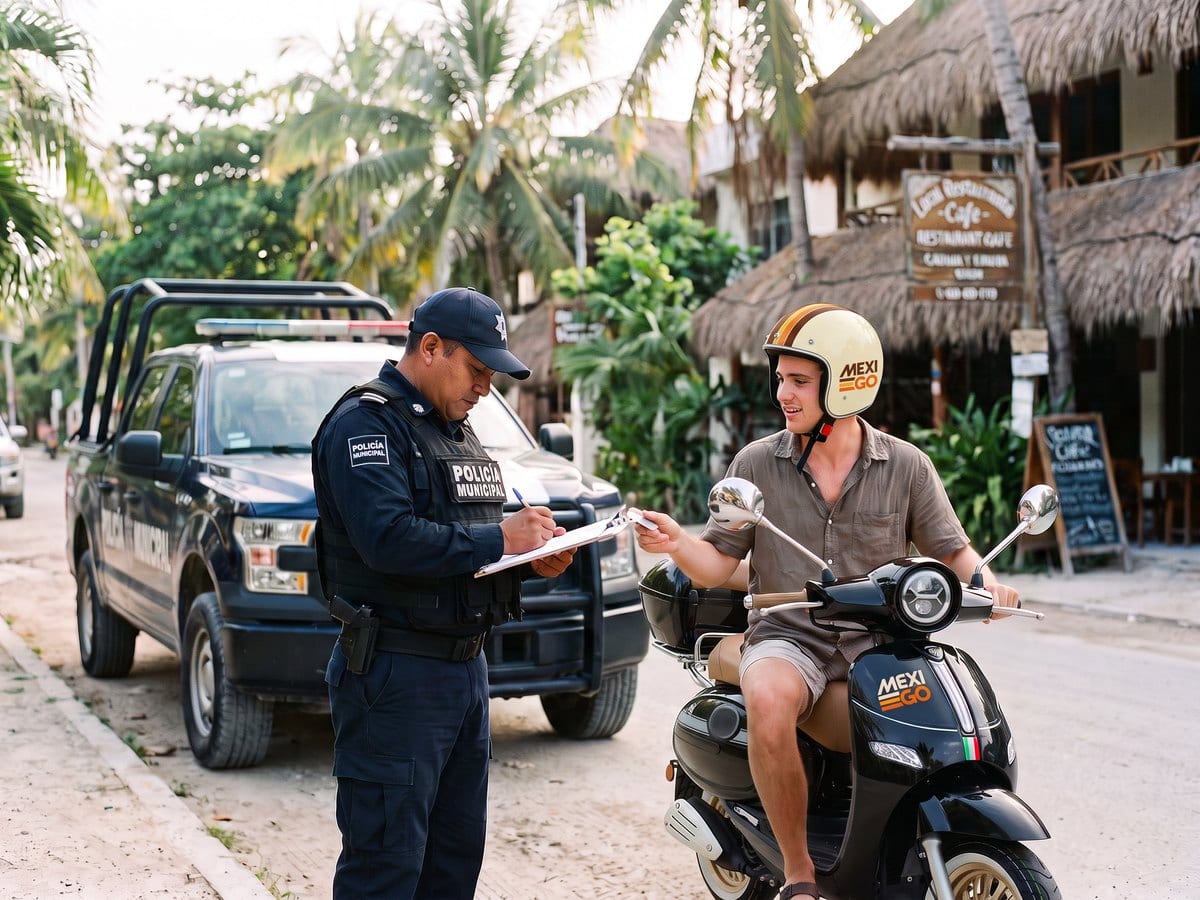
Police checkpoints are part of riding in Tulum. Most stops are routine — documents, helmet, lights — and most end with a wave-through. But almost everything that goes wrong for visitors at a stop goes wrong because nobody told them the rules before they got on the vehicle. So here they are: what a legal stop looks like, what fines really cost in 2026, and the free state-issued pass that can turn a minor fine into a warning.
We publish this as a member of 1Tulum, the coalition of Tulum businesses committed to honest information — including the hard parts.
Will the police actually stop you in Tulum?
Sometimes, yes. Checkpoints come and go around the centro and the beach road, and a scooter with two tourists on it gets looked at more than most vehicles. If your helmet is on, your lights work, and you can show a licence and your rental contract, a stop normally lasts a minute. The riders who end up with a bad holiday story are nearly always missing one of those things — or they reached for cash. Don't be either rider.
Your home-country driving licence is valid in Quintana Roo while it's current — you do not need a Mexican or an international one. What matters is the category, not the country: for a scooter it has to cover motorcycles, because a car licence does not.
When stops actually happen: after dark
Stops are not spread evenly through the day, and knowing the pattern is most of the advantage.
The large majority happen at night — and the reason is straightforward. Night is when people drive drunk or high, so night is when enforcement goes out looking for them. You are not the target of that operation, but you are on the same road as it.
Two windows in particular:
- Leaving the beach zone in the evening. This is the main one. Everyone who spent the day at a beach club leaves inside the same couple of hours, down the same few roads, and the checkpoints know it.
- Very late at night and the early hours. Prime time for people coming out of parties, and the quietest time on the road — so anything moving gets a longer look.
Ride those windows with your helmet on, your lights on and your documents on you, and a stop costs you a minute. Which road you come home on matters too: one of the three is lit and has a bike path, and the other two have neither.
What a legal traffic stop looks like
Tulum's municipal traffic regulation spells out exactly what an officer must do (Article 77):
- Signal you to stop.
- Identify themselves by name and badge number.
- Tell you the offence, and show you the article of the regulation that creates it along with the penalty.
- Check your licence and registration and hand them straight back.
If there is a fine, the officer may keep one document — or a plate — as security until it's paid. Never your passport, and never cash.
A valid ticket (Article 76) must show the articles breached, the penalty, date, time, place, your details, and the officer's name, badge number, unit and signature. No ticket, no fine.
Our coalition publishes the full article-by-article guide at 1tulum.mx/traffic-stop-rights.
If you are signalled to stop, choose where you stop
You do have to stop. You do not have to stop in the first place the siren sounds.
Pull over somewhere well lit — outside a shop, a petrol station, a hotel entrance: anywhere with people around and, just as usefully, cameras. Indicate, slow down, and carry on the short distance it takes to reach one. Nobody reads that as evading; it is simply what a sensible rider does at night.
A lit, overlooked spot changes the stop for everybody standing in it. It is better for you, because what happens is witnessed and recorded. It is better for the officer, for exactly the same reason. The stops that go badly for visitors are almost always the ones in the dark with nobody passing.
Then, engine off and hands visible:
- Ask what the offence is. You are entitled to be told it, shown the article of the regulation that creates it, and told the penalty — that is Article 77 above. A stop that cannot name an offence cannot produce a ticket.
- Stay polite and unhurried. Hostility only buys you time at the roadside.
- Let your documents be checked and handed back. They are looked at, not kept.
Tourists get a free pass — it's literally in the regulation
Article 70 of the Tulum regulation creates a courtesy ticket for tourists: a written warning instead of a fine, up to twice per vehicle or driver, for anything that isn't a serious offence. If you're stopped for something minor, ask for it politely:
«Soy turista. Le solicito respetuosamente que me expida una Boleta de Infracción de Cortesía de acuerdo con el Artículo 70.»
Save that sentence to your phone now. It does not cover serious violations — drink-driving is explicitly excluded.
Never pay cash at the roadside
Under federal law (Código Penal Federal, Article 222), a roadside cash payment is bribery — a crime for both the officer and you. Real fines are paid at the Municipal Treasury, its collection offices, or designated banks, and paying within 5 working days earns up to a 50% reduction. As 1Tulum's guide puts it: "Paying does not make it go away. It funds the next stop."
And there is a practical reason on top of the legal one: offering money does not end the conversation, it starts a different one. Once you have shown you will pay to make something go away, the number goes up. Riders who hand over "a little for the coffee" are the ones who find themselves negotiating for twenty minutes. The ones who politely ask for the written ticket are usually riding again in five.
They cannot simply search you or the vehicle
A routine traffic stop is not, in itself, grounds to search you, your bag or the scooter. Under Article 16 of the Mexican Constitution a search normally requires a warrant from a judge; the narrow exception is a crime being committed in front of the officer. "We are going to take a look" is not one of those things.
If you are asked, you can say so — calmly, once, in either language: "No autorizo la revisión." I do not consent to a search. Keep your hands visible, do not physically resist and do not try to stop anyone. You are stating a right, not starting an argument, and at midnight at the roadside those two are very easy to confuse.
If it happens anyway, do not fight it. Note the time, the place, the unit number and the officer's name and badge number, and deal with it afterwards rather than there — 1tulum.mx takes reports anonymously, in English or Spanish, and that is how a pattern actually gets addressed.
What fines actually cost in 2026
Fines are set in UMA, the national unit of account — 117.31 pesos in 2026. The ones that matter most on two wheels, from the published municipal table:
| Offence | Fine (MXN) | Vehicle towed? |
|---|---|---|
| No helmet (rider or passenger) | $1,407.72 | Yes |
| Riding against the traffic direction | $1,407.72 | No |
| Riding between lanes | $1,173.10 | Yes |
| Riding on the pavement | $1,173.10 | Yes |
| Passenger under 10 years old | $1,173.10 | Yes |
| Ignoring signs or an officer | $938.48 | No |
The full tables — including parking and alcohol — are at 1tulum.mx/fines-offences. Drink-driving means arrest, 24 hours in detention and a tow; no courtesy ticket, no pass.
Two helmet facts worth knowing: helmets are mandatory for scooter riders and passengers (Article 63 — every MexiGo scooter comes with helmets included), and the same article explicitly exempts cyclists — so there is no helmet fine on a bicycle or e-bike. We still recommend wearing one. More in our helmet law guide.
One change is coming: the state's "Ley Chaleco" will eventually require plate-stickered helmets and reflective vests on motorcycles, with no exemption for rentals or tourists — but enforcement has been deferred to 2027. We'll update this guide when it starts.
The Guest Mobility Pass: minor fines become warnings — twice
Quintana Roo runs a free program for visitors driving rental vehicles, issued through the state's official Guest Assist app. With the pass on your phone:
- Minor infractions get a warning instead of a fine — twice.
- Officers cannot confiscate your licence or passport for covered violations.
- Your QR code proves you're a legitimate visitor.
- The app carries emergency numbers and a tool to report bribe attempts.
Who qualifies: visitors (not Quintana Roo residents) with a foreign passport and a home-country licence, driving a vehicle from a registered rental company. What it never covers: drink or drug driving, parking in disabled zones, accidents that harm others, or federal and military checkpoints.
One honest note, because that's how we do things: the pass is written with rental cars in mind. If you're renting a scooter from a registered company it still costs nothing to carry and takes five minutes to set up — worst case it does nothing, best case it saves your afternoon. And on a bicycle or e-bike you don't need it at all: no licence, no plates, no fuel stops, and that cyclist helmet exemption. There's a reason we think two wheels without an engine is the happiest way around Tulum.
Guest Assist — get the pass before you ride
The official app of the Government of Quintana Roo (SEDETUR). Download it free, open the Tourist Mobility Pass section, add your details and a photo of your rental contract, and your QR code arrives by email. You can also register at guestassist.mx before your trip.
If a stop goes wrong
If you're detained, you're owed three things: to be told why (Constitution, Article 16), immediate registration in the national detention registry, and the right to contact your consulate. For emergencies dial 911. Bribe attempts can be reported through the Guest Assist app, or anonymously in English or Spanish at 1tulum.mx.
Save our assistant before you ride, not after
The single most useful thing you can do about any of this is put one number in your phone now.
Our WhatsApp assistant answers instantly, at any hour, in your language — and a roadside stop is exactly what it is good for. Ask it what the offence you are being quoted actually is, whether it matches the federal and Quintana Roo rules, what the real fine is, and where and how it is properly paid. Having a straight answer in your hand in thirty seconds is what stops a stop turning into an expensive misunderstanding.
One in the morning, at the side of an unlit road, is the worst possible moment to be working out what is true. That is the moment people agree to things they should not. Save it now.
Message the MexiGo assistant on WhatsApp →
Ride so none of this ever matters
Helmet on, lights on, licence and rental contract photographed on your phone, never drink and ride — that's the whole game. One detail people only think about when it's too late: your rental agreement arrives by email when you book, and at a stop it's how you show the scooter is legitimately yours — so give the rental shop an email you actually read, typed correctly, and keep that message for the whole trip. If you're weighing up your options: our scooter legality guide covers what you need before renting a scooter, scooter vs e-bike settles the licence question, and is a rental car worth it in Tulum? is the read if the Guest Mobility Pass made you think four wheels. For the big picture, see getting around Tulum.
Questions people ask
- What do I have to show at a police stop?
- Your driving licence — a motorcycle one for a scooter — and the vehicle paperwork, which we hand over with every rental. A helmet on both heads is the other thing immediately looked at.
- What is the Guest Mobility Pass?
- A free scheme for visitors that turns certain minor traffic fines into warnings. It costs nothing to register and is worth doing before you ride.
- Can I be asked to pay a fine on the spot?
- A legitimate fine is issued as a written ticket, not collected at the roadside. If you are asked to pay cash in person, you are entitled to ask for the ticket instead.
- What if I do not have a motorcycle licence?
- Then do not rent a scooter. Expect a fine and the vehicle being impounded, and your rental agreement will leave you carrying whatever follows — an e-bike needs no licence and goes most of the same places.
- When are you most likely to be pulled over in Tulum?
- At night, by some distance. Night is when people drive drunk or high, so night is when enforcement is out looking for them — and you share the road with that operation whether or not you are its target. The two busiest windows are the evening exodus from the beach zone, when everyone leaves within the same couple of hours down the same few roads, and the early hours, when people are coming out of parties and anything moving gets a longer look.
- Where should I pull over if the police signal me?
- Somewhere well lit, with people around and ideally cameras — outside a shop, a petrol station or a hotel entrance. You must stop, but you do not have to stop at the exact spot the siren sounds: indicate, slow down and carry on the short distance to somewhere overlooked. It is better for you because what happens is witnessed, and better for the officer for the same reason. Stops go wrong in the dark with nobody passing.
- Can the police search me or my scooter at a traffic stop?
- Not as a matter of routine. Under Article 16 of the Mexican Constitution a search normally needs a warrant, with a narrow exception for a crime being committed in front of the officer, and a traffic stop is not by itself grounds. You can decline calmly — "No autorizo la revisión" — but keep your hands visible and never physically resist. If it goes ahead regardless, do not fight it: note the time, place, unit number and the officer's name and badge, and report it afterwards at 1tulum.mx, which takes reports anonymously.
- What happens if I offer money to make it go away?
- It is bribery under Article 222 of the federal penal code, and a crime for both of you. It also does not work in the way people hope: once you have shown you will pay, the number goes up. Ask for the written ticket instead — fines are paid at the Municipal Treasury, its collection offices or designated banks, with up to 50% off if you pay within five working days.
- How can I check what a fine should actually be?
- Message the MexiGo WhatsApp assistant. It answers instantly at any hour, in your language, and it carries the federal and Quintana Roo rules, the real fine amounts and how and where they are properly paid. Save the number before you ride rather than trying to find it at the roadside at one in the morning.