
Riding a Scooter in Tulum: What To Do and What Not To
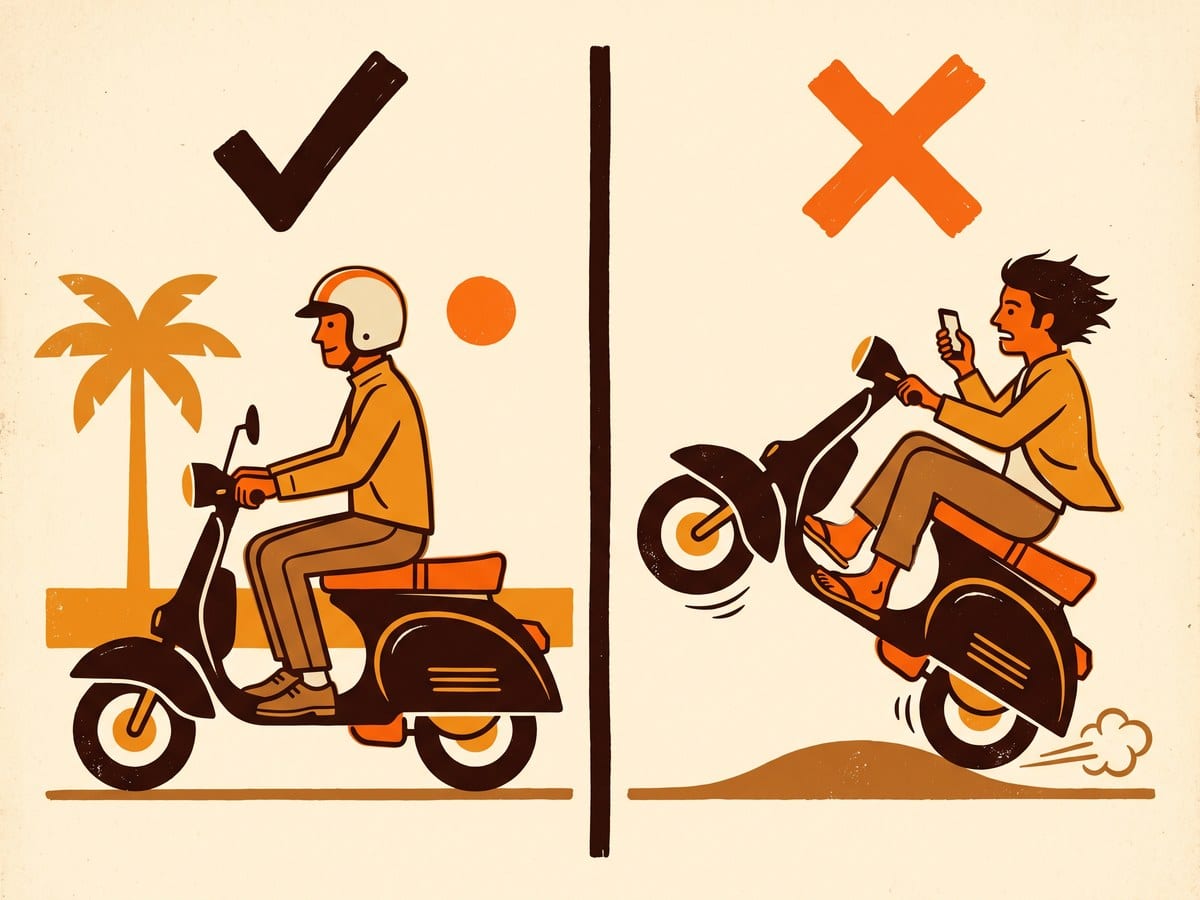
Most scooter accidents in Tulum are not dramatic. Nobody is racing. They happen at low speed, on a road that changed underneath somebody who was not expecting it, or behind a car that turned without warning.
We hand over scooters every day and we hear how the bad mornings happened. This is that, written down.
Start with the honest bit: experience matters
A scooter is easy to operate and that is exactly what catches people out. Twist and go takes two minutes to learn. Reading a road surface, judging what the car in front is about to do, and knowing what to do when something goes wrong take considerably longer.
If you have never ridden, Tulum is a survivable place to learn but it is not an easy one. Tell us at the shop and we will take the time with you. There is no pride lost in starting on an e-bike for a day first.
The road changes under you without warning
This is the single thing visitors are least prepared for. Tarmac turns to dust and loose gravel in a second, mid-corner, with no sign and no change in colour until you are on it. A road that was perfect yesterday can have a sand drift across it today.
At night it is very hard to see coming. Headlights flatten the surface and the texture disappears, so the first warning you get is the feel of the tyres going light. Ride slower after dark than feels necessary.
The front brake will put you on the floor
If you remember one thing from this page, this is it.
On these roads, do not use the front brake until you are almost stopped. Brake with the rear, and bring the front in only at the very end when you are already slow and upright.
The reason is simple and unforgiving. A front wheel that locks on dust, sand or gravel does not slow you down — it slides out sideways, and once it goes there is nothing you can do to save it. The rear wheel stepping out can often be ridden through. The front cannot. You and the scooter go down together, and you will be the softer of the two.
This is why the surface point above matters so much. The dust is what turns an ordinary stop into a crash.
Do not panic
Almost everything recoverable becomes unrecoverable the moment somebody grabs a handful of brake and freezes.
If the back steps out, stay off the front brake, look where you want to go and let it settle. If a car pulls out, brake progressively rather than snatching. Panic is what turns a fright into an injury, and the way to avoid panicking is to be going slowly enough to have time.
Do not ride close behind cars
Leave far more space than you would at home, for one specific local reason: indicators are optional here in practice. A great many drivers simply turn. No signal, no warning, often from the wrong lane.
Sitting close behind a car means that when it stops or turns, you have no time and no options. Hang back. You lose nothing — you will both arrive at the same tope anyway.
Just because the scooter can keep up does not mean you should
A 150cc scooter will happily sit at highway speed with the traffic. That is not the same as it being a good idea, and it is not the same as you being able to stop in what is in front of you.
Ride at the speed that leaves you time to react to a surface change, a tope you have not seen or a car turning across you. That is usually slower than the traffic, and that is fine.
Confidence is what crashes people
Day one, everybody is careful. Day three, the scooter feels easy and the road feels familiar, and that is reliably when it goes wrong.
The riders who get hurt here are rarely the nervous ones. They are the ones who have had two good days. Do not let road rash be the thing that humbles you — it heals slowly, it ruins a holiday, and it is entirely avoidable by riding day three the way you rode day one.
Lights on, always — day and night
Ride with your lights on in full daylight. A scooter is a narrow, easily missed shape, and being seen a second earlier is the whole game.
And the other half of that: just because you cannot see them does not mean they are not there. Assume a vehicle is in the place you have not checked.
Use your indicators, even when the road looks empty
Yes, local drivers often do not. Do it anyway.
Partly because it is the only way anybody knows what you intend, and partly because roads here are not only used by cars. Cyclists, pedestrians, dogs and people stepping out between parked vehicles are all around you, and some of them are watching you more closely than any driver is.
Your passenger is part of the bike
A pillion changes how a scooter behaves completely, and most passengers have no idea they are doing anything wrong.
Feet stay on the pegs at all times — including at a stop, and including when getting on and off. And they should sit still. Leaning to look at something, turning around, or shifting at the wrong moment unbalances the scooter, and the rider has to correct for it at exactly the time they should be concentrating on the road.
Tell them before you set off, not while you are riding.
Where you park is not where other scooters are parked
A row of scooters outside a bar does not mean that spot is legal. It frequently means several people are about to have the same bad afternoon.
And this matters more on a rental. A rental scooter is more likely to be towed, and recovering one is not a quick errand — it is half a day at the impound lot, plus the taxis to get there and back, plus the fee. That is a day of your holiday gone and more money than the rental cost.
If you are not certain, ask. We would far rather tell you where to leave it than see you lose an afternoon to it.
Do not leave anything in the scooter
The storage under the seat is convenient and it is not secure. These are not difficult to get into, and a parked scooter is an obvious target.
Take your bag, your phone and your documents with you. Leave nothing visible and nothing valuable under the seat, not even for ten minutes.
And look after the helmet
Helmets come with every scooter and they cost you nothing, but they are not indestructible and they are part of what your deposit covers.
Do not drop it. A helmet dropped onto concrete can be finished even when it looks perfectly fine, because the crushable liner inside is a one-time device — which is exactly the property that protects your head. A damaged helmet has to be retired and replaced, and that comes out of the deposit. Hook it on the mirror or take it with you; do not balance it on the seat.
The short version
- Do ride with your lights on, day and night
- Do use your indicators, even when the road looks empty
- Do leave a lot of space behind cars
- Do tell your passenger to keep their feet on the pegs and sit still
- Do ask us where it is safe to park
- Do not touch the front brake until you are nearly stopped
- Do not panic — slow down enough that you have time not to
- Do not match the traffic just because the scooter can
- Do not get confident on day three
- Do not leave anything under the seat
- Do not drop the helmet
None of this is meant to put you off. Riding here is genuinely one of the best things about Tulum — the cenotes, the coast road at seven in the morning, the freedom of not negotiating a taxi fare. It is just a place that rewards riding slightly more carefully than you think you need to.
Worth reading next: what the helmet law actually says here, and licences, police stops and your rights.
We are a member of 1Tulum, a coalition of Tulum businesses held to one published standard, part of which is telling you the inconvenient thing — in this case that the easiest vehicle to operate is not the easiest one to ride.
Questions people ask
- What is the most common mistake visitors make?
- Grabbing the front brake. On sand or gravel it will put you on the floor — use the rear brake first and come off the throttle earlier than you think you need to.
- Do I really need closed shoes?
- Yes. In an emergency stop your foot goes down hard on whatever is there, and a flip-flop comes off or folds under. Sneakers are best; anything closed and fastened will do.
- Is it safe to ride at night?
- Less so. Lighting is patchy outside the centre, the topes are much harder to see, and so is everybody else on the road. If you are riding after dark, go slower than feels necessary.
- What do I do if the scooter breaks down?
- Call the shop. That is what the number is for, and it is one of the better reasons to rent from somewhere with a physical address you can go back to.