
Salt, Dust and Topes: What Tulum Does to a Scooter
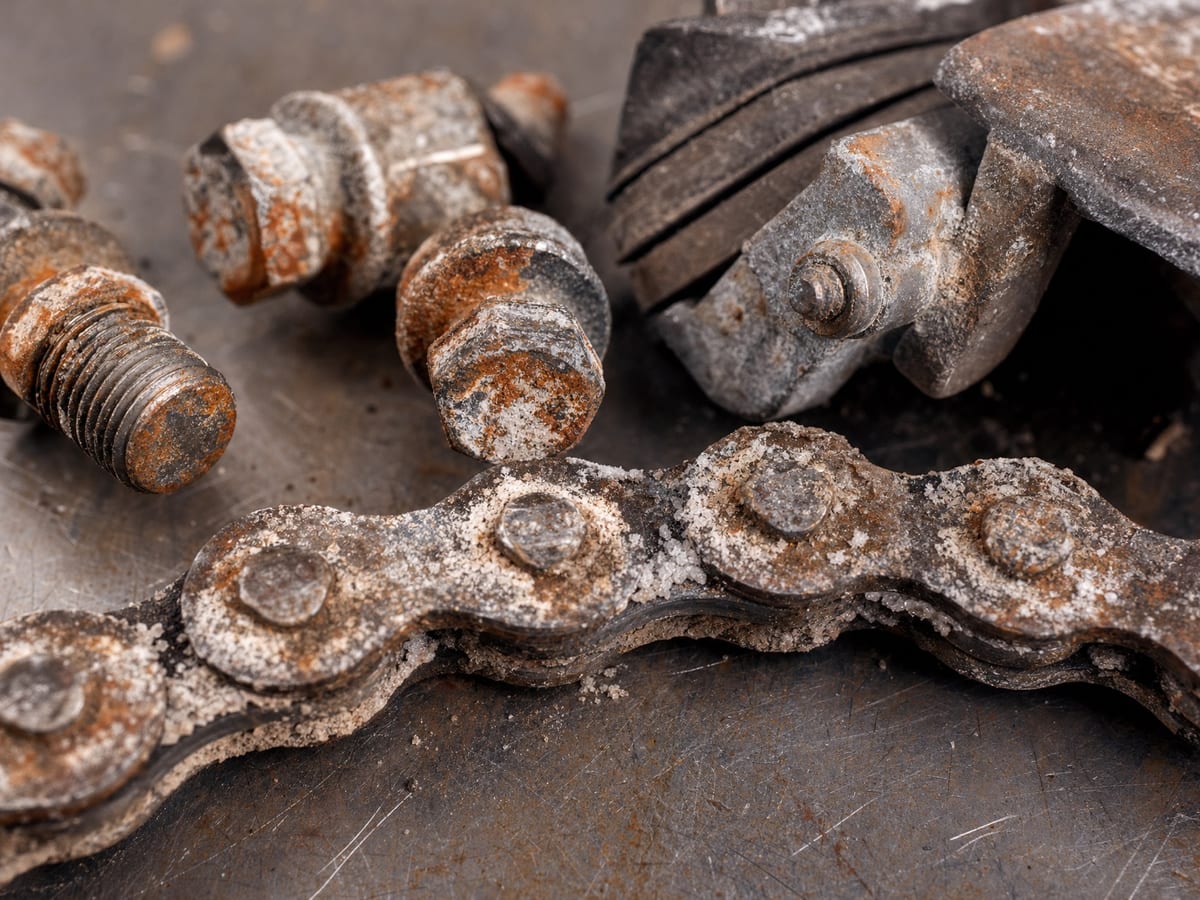
Tulum eats vehicles.
Not dramatically, and not all at once. It does it quietly, through salt in the air and limestone dust in everything and a road surface that punishes anything with wheels. A scooter that would run for years in a dry inland city will need serious attention here inside a season.
This is the part of a rental business nobody writes about, so here it is: what this place actually does to a fleet, and what we do about it.
Challenge one: the salt air, which beats everything
We are a few hundred metres from the Caribbean, in humidity that rarely drops. That combination is the single hardest thing about keeping vehicles here, and it is worse than most people assume.
Even stainless steel does not survive it. People hear "stainless" and think solved problem. It is not. Stainless resists rust because it holds a thin passive oxide layer, and airborne chlorides break that layer down locally, which starts pitting corrosion underneath. The surface can look fine while the metal is quietly failing in a pinhole you cannot see. On a brake fastener that matters.
What it actually looks like day to day:
- Bolts that seize into their threads and shear rather than turn
- Brake and gear cables corroding inside their housings, where no inspection finds them until something stops moving
- Electrical connectors going green, which shows up as an intermittent fault that is maddening to chase
- Aluminium parts bolted to steel ones corroding faster where the two metals meet
- Chains that show surface rust overnight if they are left even slightly dry
Challenge two: dust, and what it does to a carburettor
The whole peninsula is limestone. The dust here is fine, pale and abrasive, and in dry season it is in the air, on the roads and inside everything. Add blown sand near the coast and you have a mixture that behaves like a mild grinding paste.
On our scooters it goes for the fuel system first. Dust clogs carburettors — it loads the air filter far faster than any service manual assumes, and once the filter is past its best, fine particles reach the jets. A partly blocked jet does not stop a scooter; it makes it run badly, hesitate, idle rough and drink fuel. Left alone it gets worse.
It is just as hard on bicycles. Dust sticks to a freshly oiled chain and turns the lubricant into an abrasive, which wears the chain and the sprockets together. It gets into unsealed bearings. It settles on braking surfaces.
Challenge three: the roads
The roads here are a genuine mechanical problem, not a complaint about comfort.
The topes — speed bumps — are tall, frequent and often unpainted. Hitting one you did not see transmits a real shock through the wheel, the forks and the frame. Multiply that by every rental, every day.
Then there are the unpaved shoulders, the potholes that open up after heavy rain, and the stretches where tarmac turns to gravel without warning. The result is constant stress on exactly the parts you do not want failing: wheel bearings, spokes, suspension, welds, and the fasteners that hold everything together — the same fasteners the salt air is already working on.
That combination is the thing. Corrosion weakens, and vibration finds the weakness.
Challenge four: heat, rain, and parts that are months away
Heat ages everything soft — rubber, plastics, cables, tyres, batteries. Wet season drives water into places it should not go and makes every electrical fault more likely.
And when something does fail, you cannot simply order the part. Specialist stock often has to be imported, and lead times of weeks or months are normal rather than exceptional. A bike waiting on a part is a bike earning nothing, which is a large part of why renting here costs more than in Bali or Thailand.
So what do we actually do about it?
None of the above is solvable. All of it is manageable, and the way you manage it is by assuming the environment wins unless you stay ahead of it.
Service by condition, not by mileage
Service schedules in a manual assume a temperate climate and clean air. Here they are optimistic. We check vehicles between every rental rather than at an interval, because a vehicle that did three dusty days to the cenotes has had a harder life than one that did a week on the beach road.
Air filters far more often than the book says
This is the cheapest intervention with the biggest effect on a carburetted scooter. A clean filter is what stops dust reaching the jets in the first place. Cleaning filters often is dull, unglamorous work, and it prevents most fuel-system problems before they start.
Carburettors cleaned on a schedule, not on a complaint
Waiting for a customer to report a rough-running scooter means the customer has already had a bad morning. Carbs get stripped and cleaned as routine maintenance, not as a repair.
Fresh water, then grease
Salt is removed, not resisted. Vehicles get rinsed, and then the places that matter get protected: dielectric grease in electrical connectors, anti-seize on fasteners so they can still be undone in six months, and lubricant on cables rather than only on the obvious moving parts.
Wax on chains instead of wet oil
Heavy wet oil on a chain here collects dust and becomes a grinding compound. Drier lubricants attract less of it. It is a small choice that measurably extends the life of a drivetrain in this climate.
Sealed bearings, and replacing rather than nursing
Where a sealed component is available we use it, because anything open fills with dust. And when a part is corroded, it gets replaced. A seized bolt that is persuaded to turn is a bolt that will fail later, probably at a worse moment.
Holding our own spares
Because parts are months away, the stock has to be here already. Holding spares ties up money that would otherwise be doing something useful. It is an expense that exists purely so a vehicle does not sit dead waiting for a shipment.
Retiring vehicles earlier than you would elsewhere
The honest conclusion of everything above: a vehicle here has a shorter working life than the same vehicle somewhere dry. Keeping one past its point is how rental shops end up handing people machines that fail on the road.
What this means when you rent, from anyone
You do not have to take our word for any of it. Here is how to assess a rental vehicle in Tulum in about a minute, at our shop or at anybody else's:
- Squeeze both brake levers before you leave. Spongy, or travelling most of the way to the bar, means neglected cables or fluid.
- Look at the chain. Surface rust, or a thick dark paste of oil and dust, tells you how the rest is maintained.
- Check the tyres for cracking in the sidewall, not just tread. Heat kills rubber here.
- Start a scooter and let it idle. Hunting, stalling or a reluctance to pick up cleanly is usually the fuel system, and the first symptom of the dust problem.
- Look at the bolt heads. Rounded or rusted fasteners mean things have been forced rather than serviced.
- Ask when it was last serviced. A shop that maintains properly will answer immediately and specifically.
It also explains something people ask us about constantly: why there is a deposit. It is not a profit centre. In an environment this hard on machinery, the difference between a fleet that works and one that strands people is maintenance that never stops, and vehicles coming back in the condition they went out is what makes that possible.
We are a member of 1Tulum, a coalition of Tulum businesses held to one published standard, part of which is honest information including the unflattering parts. The unflattering part here is simple: this place is hard on vehicles, ours included. The difference is what you do about it.
Questions people ask
- How can I tell a well-maintained rental?
- Squeeze both brake levers before you leave, look at the chain, check the tyres for cracking in the sidewall rather than tread, and ask when it was last serviced. A shop that maintains properly answers immediately and specifically.
- Does salt air really affect stainless steel?
- Yes. Airborne chlorides break down the thin passive layer that makes stainless resist rust, and pitting starts underneath. The surface can look perfectly fine while the metal is quietly failing.
- Why does renting cost more here than in Asia?
- Imported parts with long lead times, salt air that destroys components, and roads that punish everything with wheels. A vehicle here has a shorter working life than the same vehicle somewhere dry.
- What does this have to do with the deposit?
- Everything. In an environment this hard on machinery, the difference between a fleet that works and one that strands people is maintenance that never stops — and that depends on vehicles coming back as they went out.