
Why Rental Costs More in Tulum than Bali or Thailand (2026)
If you have rented a scooter in Bali for five dollars a day, or in Phuket for two hundred baht, the price of renting one in Tulum can come as a shock. It is a fair question to ask, and "Mexico is expensive" is not a real answer.
So here is the honest one, line by line. We rent bicycles, e-bikes and scooters in Tulum, we pay all of these costs every month, and almost none of them are costs a rental shop in Canggu or Chiang Mai has to carry.
The short answer
A scooter in Tulum costs more to rent than the same scooter in Bali or Thailand because of six things, roughly in order of weight:
- The vehicle is imported. Indonesia and Thailand build millions of scooters a year at home. Mexico imports almost all of them, and pays duty plus 16% IVA on the landed value.
- Spare parts are imported too, then shipped 1,500+ km to the Yucatán peninsula — and salt air and sand wear everything out faster here.
- Insurance is real and mandatory. A commercial fleet policy in Mexico is a serious annual cost. In much of Southeast Asia the cheap rental is simply uninsured.
- Operating legally in Tulum is expensive — municipal licence, land-use permit, civil-protection sign-off, vehicle registration per unit, and federal-zone concessions for anything near the beach.
- Mexican tax and labour law are formal and generous: 16% IVA inside every price, corporate income tax at 30%, mandatory social security, a Christmas bonus and paid holiday for every member of staff.
- Tulum's commercial rent is quoted in US dollars and competes with restaurants and boutiques, not with a motorbike shed.
None of that is a complaint. Most of it is the reason a rental here comes with a helmet, a serviced vehicle, an insured ride and a receipt. But it does mean the floor under the price is much higher than it is in Bali.
Where the money actually goes
| Cost driver | Tulum, Mexico | Bali, Indonesia | Thailand |
|---|---|---|---|
| Where the scooter is built | Imported — 31% import tax on landing | Built in-country in the millions | Built in-country; global export hub |
| Spare parts | Imported, then freighted to the peninsula | Corner shop, same day, cents | Corner shop, same day, cents |
| Road conditions | Topes, potholes, sand and limestone dust — brutal on every component | Mostly sealed urban roads | Mostly sealed urban roads |
| VAT inside the price | 16% | 11% | 7% |
| Corporate income tax | 30% | 22% | 20% |
| Fleet insurance | Mandatory, commercial policy | Commonly none on cheap rentals | Commonly none on cheap rentals |
| Staff cost on top of wages | Social security, housing fund, Christmas bonus, paid holiday | Far lighter | Far lighter |
| Commercial rent | Priced in USD, tourist-boom market | Low, local currency | Low, local currency |
| Card acceptance | ~6% all-in for the business | Mostly cash | Mostly cash |
1. The scooter itself costs more before it ever turns a wheel
This is the single biggest difference, and it has nothing to do with Tulum.
Indonesia builds something in the order of six million motorcycles and scooters a year. Thailand is one of the world's motorcycle manufacturing hubs. A rental shop in either place buys a brand-new, locally assembled 125cc scooter at a domestic price, with no import duty, no customs broker and no freight bill.
Mexico does not build them at anything like that scale. Almost every scooter on the road here arrived from China, India or Japan, and arriving is the expensive part: a scooter imported into Mexico lands carrying 31% in import tax. That is before it has been freighted to the peninsula, registered, insured, or ridden a single kilometre. Even Italika, the Mexican brand that outsells everyone, assembles in Toluca, almost 2,000 km from Tulum, and that journey is on the invoice too.
The practical result: the identical machine can cost a Tulum operator a multiple of what it costs a Bali operator. Every rental day has to pay back a much larger purchase.
2. The roads here are the real cost
If we had to point at one thing that makes a scooter more expensive to run in Tulum than almost anywhere else, it would not be tax. It would be the roads.
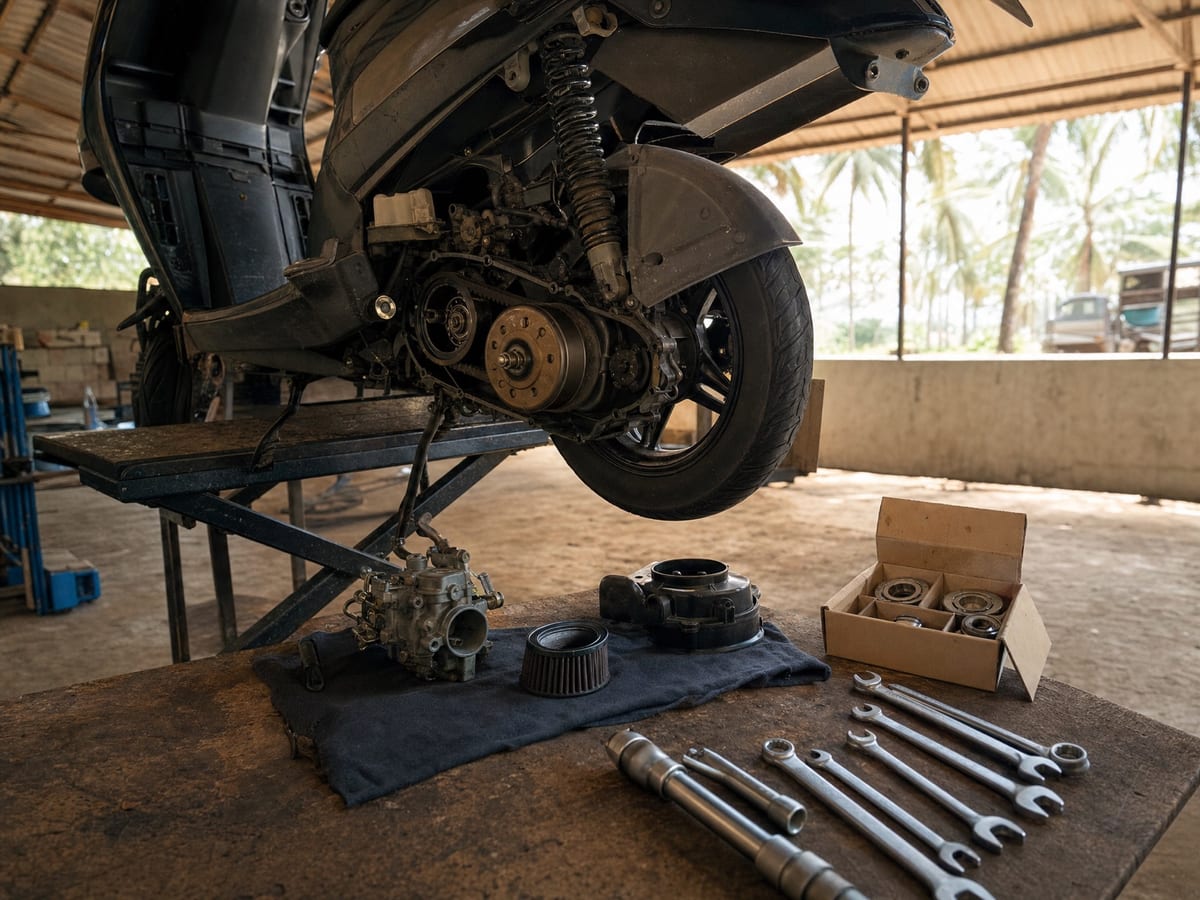
Topes, potholes, sand and limestone dust destroy vehicles. Every unpainted speed bump is a hammer blow through the forks, the wheel bearings and the welds. The dust gets into the air filter and then into the carburettor. Sand gets into the brakes. A scooter that would run for years on sealed city roads needs real attention here inside a season — and that is maintenance we pay for on every single vehicle, continuously, not a cost we can defer.
3. Parts, salt air and the cost of a bike standing still
In Bali or Thailand, a brake cable, a CDI unit or a set of pads is a five-minute walk away for pocket change. In Tulum, a lot of it is ordered in, imported, and then trucked across the country.
Then there is the climate. Tulum sits in salt air, sand and heavy rain. Chains, bearings, brake discs, spokes, cables and electrical connectors corrode here far faster than they do inland anywhere. A bicycle in Tulum needs real servicing on a schedule, not when something breaks.
So a serious shop carries spare inventory and services the fleet preventatively — which costs money — or it rents out vehicles that are quietly falling apart, which costs the customer. There is no third option, and the cheap end of the market everywhere in the world picks the second one.
4. Insurance: the cost the cheap option skips
A legally operated rental fleet in Mexico carries commercial vehicle insurance. Civil-liability cover is a legal requirement for motor vehicles, and insuring vehicles that are handed to a different foreign rider every day is priced accordingly. It is one of the larger fixed lines in the business.
This is worth understanding before comparing prices across countries. A great deal of the very cheap scooter rental in Southeast Asia is uninsured — and riders frequently find out, after an accident, that their travel insurance also excludes them because they were not licensed to ride that vehicle. (In Mexico the licence question has a clear answer — we cover it in driving a scooter in Tulum: licences, police stops and your rights.)
Our security deposit on a scooter is MXN $4,000, and it is set to correspond to the standard insurance excess rather than to the value of the bike. That is only possible because there is a policy behind it.
5. Permits, concessions and the price of being a real business
A rental store in Tulum operates under a stack of permissions, each with its own fee, renewal and inspection:
- a municipal operating licence (licencia de funcionamiento) from the Tulum municipality, renewed annually;
- a land-use permit (uso de suelo) for commercial activity at that exact address — tourist Tulum is zoned, and the zoning is enforced;
- civil protection sign-off: extinguishers, exits, signage, inspection;
- registration and plates for every vehicle in the fleet, with the annual state renewal on each one — fifty vehicles means fifty registrations, not one;
- federal maritime-zone (ZOFEMAT) concession fees for any operation on or beside the beach, plus the tourist-service permissions the state requires;
- registration as an employer with IMSS (social security) before anyone is hired.
Tulum is formalising quickly — new airport, new rules, far more enforcement than five years ago. That is good news for visitors and a real cost for operators. The guy renting scooters from a hotel lobby in a country with no such regime has none of it.
6. The tax system: 16% is already inside the price you see
Mexican consumer prices are quoted IVA included, so when you see a price from us, 16% of it is value-added tax that we collect and hand to the government. Thailand's VAT is 7%. Indonesia's is 11%. On a like-for-like basis, that difference alone puts Mexico most of a tenth of the price ahead before anything else happens.
On top of that: corporate income tax at 30%, monthly provisional payments, mandatory electronic invoicing (CFDI) for every transaction, and the accountant that compliance requires. Mexico's tax system is modern and digital, which also means it is very hard to be casually informal in it — and much of the price gap with Bali is, bluntly, the gap between a formal business and an informal one.
7. Rent: Tulum is priced in dollars
Commercial rent on a visible street in Tulum is quoted in US dollars and competes with restaurants, dive shops and boutiques for the same few hundred metres of frontage. The tourist boom that makes Tulum worth visiting is the same boom that sets the rent.
A rental operation in Canggu or Ao Nang pays local-currency rent, usually a fraction of it, often for a space that does not need to look like anything.
8. Electricity, water and the cost of 32°C
Commercial electricity in Mexico is not subsidised the way domestic supply is, and the business tariff is considerably higher per kilowatt-hour. In Tulum you are cooling a store, charging e-bike batteries, and running lights and compressors in heat and humidity for most of the year. Water, waste, internet and card terminals all carry business rates too.
9. Staff: Mexican labour law is deliberately generous
A properly employed member of staff in Mexico comes with, by law:
- IMSS social security contributions, plus the INFONAVIT housing fund and retirement savings;
- an aguinaldo — a Christmas bonus of at least 15 days' pay;
- paid annual holiday of at least 12 days in the first year, with a 25% holiday premium on top;
- a state payroll tax, and statutory severance if the job ends.
Put together, employing someone legally in Mexico costs meaningfully more than their wage. We think that is how it should be — our mechanics and front-desk staff are the reason the fleet is safe and the hand-over takes four minutes — but it is a cost structure the informal competition abroad does not share.
10. Card fees, and why cash gets 5% off
Accepting a card in Mexico costs the business around 6% all in, once the acquirer's fee and IVA on that fee are counted. That is high by international standards, and on a low-margin daily rental it is not a rounding error.
It is exactly why we give a 5% discount for paying in Mexican pesos in cash — we pass the saving on rather than building it into everyone's price.
11. Season: the same fixed costs, fewer rental days
Tulum has a genuine low season. September and October are quiet, and the rent, insurance, permits, payroll and loan payments all arrive anyway. Bali and much of Thailand rent year-round. Fixed costs spread over fewer paid days mean a higher price per day — that is arithmetic, not greed.
So what are you getting for the difference?
Being expensive is only defensible if the money shows up somewhere. For a rental in Tulum it should buy you:
- a vehicle that is actually maintained, on a service schedule, in a climate that destroys neglected machines;
- insurance that exists, with a deposit tied to the policy excess rather than to the price of the bike;
- a helmet included with every scooter, and a legal hand-over where someone checks your licence — because insurance is void without one;
- a refundable deposit with options — pesos, a card pre-authorisation that is frozen and never charged, foreign cash, or a passport held securely — rather than someone keeping your passport as leverage;
- a written rate, a receipt and a real address to come back to if something goes wrong;
- staff who are paid and insured.
How to pay less in Tulum without taking a risk
Practical, and all of it applies to us:
- Rent for longer. Daily rates drop with length — a week is far cheaper per day than two days. The discount is automatic when you pick your dates.
- Pay in pesos, in cash, for 5% off the rental.
- Ask whether you need a scooter at all. Tulum is flat. A bicycle covers Centro, La Veleta and the beach road comfortably; an e-bike covers all of it plus the nearer cenotes, needs no licence, and costs a fraction of a scooter. For most visitors the honest recommendation is an e-bike — we compare the two in scooter vs e-bike in Tulum.
- Book ahead in high season. December to April the good vehicles go first, and walking the strip at 10am looking for a last-minute scooter is how people end up on a bad one at a bad price.
- Compare what is included, not the headline number: helmet, insurance, deposit terms, the state of the bike, and whether the shop will still be there tomorrow.
See live prices and availability for every bicycle, e-bike and scooter in both of our Tulum stores — rates, length discounts and deposits, with nothing hidden until checkout.
Written by the team at MexiGo Rentals, Tulum. We rent bicycles, e-bikes and scooters from two stores in Tulum, with helmets, insurance and a refundable deposit you choose. Questions about licences, deposits or insurance? The FAQ answers them in detail, or talk to us.
Questions people ask
- Why is renting here more expensive than in Bali or Thailand?
- Imported vehicles and parts carry duty, prices include 16% IVA, insurance and municipal permits are real costs, commercial rent is quoted in dollars, and Mexican labour law is not Thai labour law. None of that exists in the comparison people are making.
- Is the cheapest rental in Tulum a good idea?
- Sometimes. But a price well under everyone else usually means something has been removed — insurance, maintenance, paperwork, or a helmet you are then charged for. Ask what is included before you compare numbers.
- What am I actually paying for?
- A vehicle that was serviced between rentals in a climate that destroys machinery, insurance on every scooter day, helmets at no charge, and a shop with an address you can return to.
- Does renting for longer bring the price down?
- Yes, substantially. The daily rate falls as the rental gets longer — a week costs far less per day than a single day, and a month less again.