
Fuel in Tulum: how Mexican petrol stations work on a scooter
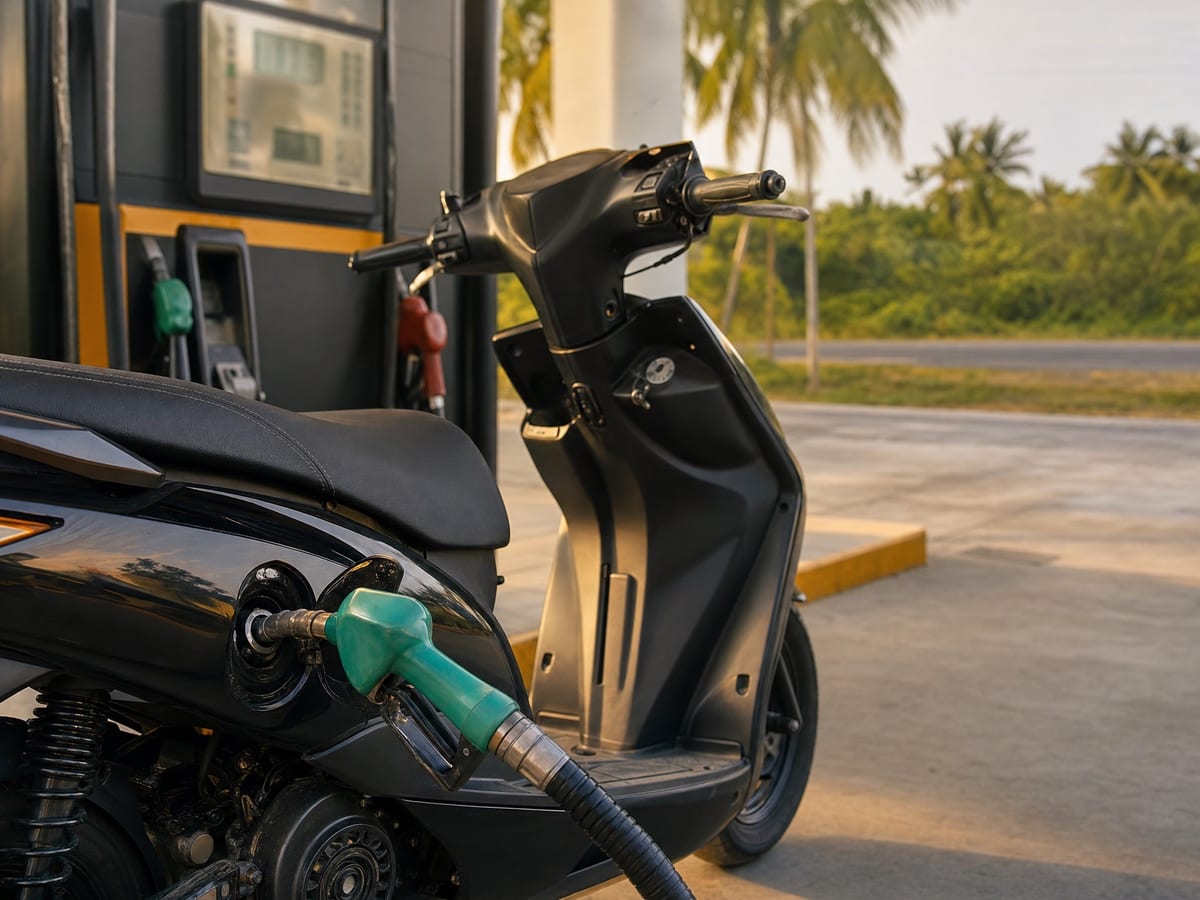
Nobody writes this one, because nobody who lives here remembers it needs explaining. But if you have just picked up a scooter and you are from somewhere with self-service petrol, the first fill-up in Mexico is genuinely confusing — and there is one piece of it worth knowing before you pull in rather than after.
You do not fill it yourself
There is no self-service in Mexico. You pull up, stay on the bike or stand beside it, and an attendant does the whole thing. This catches almost every visitor on day one, usually standing at the pump holding the nozzle while somebody walks over.
What to say is short:
- "Lleno de magna, por favor." — Fill it up with regular, please.
- Magna is the green pump. That is regular petrol and it is what a scooter takes. The red pump is premium and you do not need it.
- If you only want a set amount, say the number in pesos: "Cien de magna, por favor."
The one thing to actually watch
Check the pump reads zero before they start. Say it out loud if you like — "de cero, por favor", from zero please — and glance at the display.
This is the standard advice everyone in Mexico gives, locals included — but we are not going to pretend it lands on everyone equally. A scooter that is obviously a rental, a rental helmet and an accent make you identifiable before you have said a word, and anyone looking for an easy mark can see you coming. That is a tourist-town truth rather than a Mexican one; it is just as true in Rome or in Bali.
The other half of the truth matters just as much: most attendants are completely honest, work long shifts in real heat, and live on tips. So none of this has to be delivered as an accusation. Say it cheerfully, watch the total as it fills, check your change against the display, tip a few pesos and ride off. Two seconds of looking removes the one part of the transaction that is impossible to argue about afterwards.
What a fill should actually cost
This is the number worth carrying, because it turns a vague worry into something you can check while it is still happening.
Magna is running at roughly $24 to $25 a litre in Tulum at the moment, across the twenty-five or so stations in town. Most 125–150cc scooters hold between five and seven litres.
Which gives you the rule: filling a scooter from near-empty should not come to much more than 150 pesos. Six litres at twenty-five is a hundred and fifty, and that is already more than most scooter tanks hold — a normal top-up is well under a hundred. If the display is climbing past two or three hundred, say something while the nozzle is still in, not afterwards.
Fuel prices move, so glance at the price board on the way in. And ask us what your particular scooter holds when you collect it, then you are carrying the real number instead of a guess.
Pay cash, and pay in pesos
Pay cash, in pesos. Plenty of stations take cards, and there are two separate reasons we point our customers at cash anyway.
The ordinary one is that "the terminal is down" is a genuinely common conversation here, and cash skips it. The one that matters more is the charge you only find later: there are well-documented cases across Mexico of travellers getting home, opening a statement and finding that a fuel stop produced a charge bearing no relation to what they agreed — sometimes under a merchant name with nothing to do with petrol. Cash is the only method where the transaction is completely finished when you ride away.
Carry small notes — 50s, 100s and 200s. Handing over a 500 for a small fill puts you in a change conversation you did not need, and the change conversation is where the oldest trick in the country lives: you hand over a 500 and are told it was a 50. The two are closer in appearance than most currencies.
And keep dollars out of it entirely. A 100 peso note and a 100 US dollar bill are roughly a twenty-fold difference in value. If both are loose in the same wallet, a hundred dollars can leave your hand looking — to you — like a hundred pesos. We have heard that one more than once. Pay in pesos, say the amount out loud as you hand it across, and keep the note in sight until your change is back in your hand.
Tipping the attendant is normal and expected: a few pesos in coins, more if they have cleaned your visor or checked a tyre. It is not obligatory and it is not large, but it is the custom and they are working for it.
Where to fill up, and when
There are stations along Avenida Tulum through the town and out on the 307 in both directions. In town you are never far from one.
Our own choice is the Mobil out on the 307 — on the stretch officially called Carretera Reforma Agraria–Puerto Juárez as it runs past Tulum. It is where our own fleet gets filled, and it is deliberately not the closest station to either shop. We ride the extra few minutes on purpose.
You are not short of choice, either: around twenty-five stations in town and more along the 307 in both directions. If a forecourt feels off when you pull in, nothing obliges you to buy there. Pull out and use the next one.
The rule that matters is about leaving town: fill up before a cenote day, Cobá, Akumal or anything on the 307. Stations thin out quickly once you are away from Tulum, and running low on a highway with no shade is a bad afternoon. It costs you three minutes at the start of the day and removes the problem entirely. Our guide to the cenote and day-trip distances is here.
How far will a tank get you?
Further than you would think — the day trips around Tulum are well within one tank on the scooters we rent. Rather than print a number that depends on the model, the load and how hard you ride, ask us when you collect it and we will tell you exactly what yours holds, what it costs to fill at today's price and what range to plan around.
We would rather you asked than guessed, because guessing is how people end up pushing one.
If something does go wrong
- Say so immediately, while the scooter is still at the pump. Almost everything is fixable in the first thirty seconds and almost nothing is fixable once you have ridden away.
- Photograph the pump display, the station sign and the receipt, and ask for the printed ticket — you are entitled to one.
- PROFECO, the federal consumer protection agency, is the body that regulates fuel stations and pump calibration, and stations are required to display their verification.
- Ring us. We are local, we speak the language, and a call from a Tulum business tends to settle a forecourt disagreement faster than a visitor can alone.
Bring it back as you found it
Our scooters go out with a full tank and we ask for them back the same way. It is not a money-making exercise, it is the only version that is fair in both directions — and fuel is one of the five things that most often costs people part of their deposit. There is a station close to both our stores, so it is a two-minute stop on the way in.
And if you are on an e-bike, none of this applies
No fuel, no stations, no attendants. The battery unlocks and lifts out with a key, so it charges indoors at your accommodation rather than needing the bike anywhere near a socket — a full charge takes about four to six hours.
That is one of the quiet arguments for an e-bike here that nobody puts on a comparison table: there is no errand attached to it. The fuller comparison is here.
Questions people ask
- Do you pump your own petrol in Mexico?
- No. There is no self-service in Mexico — you pull up and an attendant fills the vehicle for you. This surprises most visitors on their first fill-up. Say "lleno de magna, por favor" for a full tank of regular, or give an amount in pesos such as "cien de magna, por favor".
- What petrol does a scooter take in Mexico?
- Magna, which is regular unleaded and comes from the green pump. The red pump is premium and a rental scooter does not need it.
- What should I watch for at a Mexican petrol station?
- Check the pump reads zero before the attendant starts filling — you can say "de cero, por favor". It is the standard advice locals give each other, not a tourist-specific warning, and it takes two seconds. Watch the total as it fills and check your change against the display.
- Should I tip the petrol attendant in Mexico?
- Yes, a few pesos in coins is normal and expected, and a little more if they clean your visor or check a tyre. It is not large and not obligatory, but it is the custom.
- Where can I fill up a scooter in Tulum?
- There are stations along Avenida Tulum through town and out on highway 307 in both directions, so in town you are never far from one. The important habit is filling up before you leave town for cenotes, Cobá or Akumal — stations thin out quickly once you are on the 307.
- How far will a tank take me on a scooter in Tulum?
- Comfortably further than the usual day trips around Tulum. Exact range depends on the model, the load and how you ride, so ask us when you collect the scooter and we will tell you what yours holds, what a fill costs at today's price and what range to plan around.
- Do I need to return the scooter with a full tank?
- Yes. Our scooters go out full and we ask for them back full, which is the only version that is fair both ways. There is a petrol station close to both our stores, so it is a two-minute stop on the way in — and fuel is one of the more common reasons people lose part of a deposit.
- How much should it cost to fill a scooter in Tulum?
- Regular petrol (magna) is around $24 to $25 MXN a litre in Tulum, and most 125-150cc scooters hold five to seven litres. A fill from near-empty should therefore come to roughly 125 to 175 pesos, and about 150 pesos is the sensible ceiling to keep in your head — a normal top-up is well under a hundred. Prices move, so check the price board on the way in.
- Should I pay cash or card at a Mexican petrol station?
- Cash, in pesos. Card terminals are often genuinely out of service, and there are well-documented cases across Mexico of card charges from fuel stops turning up on statements later, sometimes under unrelated merchant names. Cash is the only method where the transaction is completely finished when you ride away.
- Can I pay in US dollars at a Tulum petrol station?
- Avoid it. A 100 peso note and a 100 US dollar bill differ by roughly twenty times in value, and having both loose in one wallet is how visitors lose a lot of money in a second. Pay in pesos, carry small notes, say the amount out loud as you hand it over, and keep any dollars somewhere separate.
- What should I do if I think I have been overcharged for fuel?
- Say so immediately, while you are still at the pump — almost nothing is fixable once you have ridden away. Photograph the pump display, the station and the receipt, and ask for the printed ticket. PROFECO, the federal consumer protection agency, regulates fuel stations and pump calibration. If you are renting from us, ring us: a local call often settles a forecourt disagreement faster than a visitor can alone.