
Can You Rent an ATV or Quad Bike in Tulum? (2026)
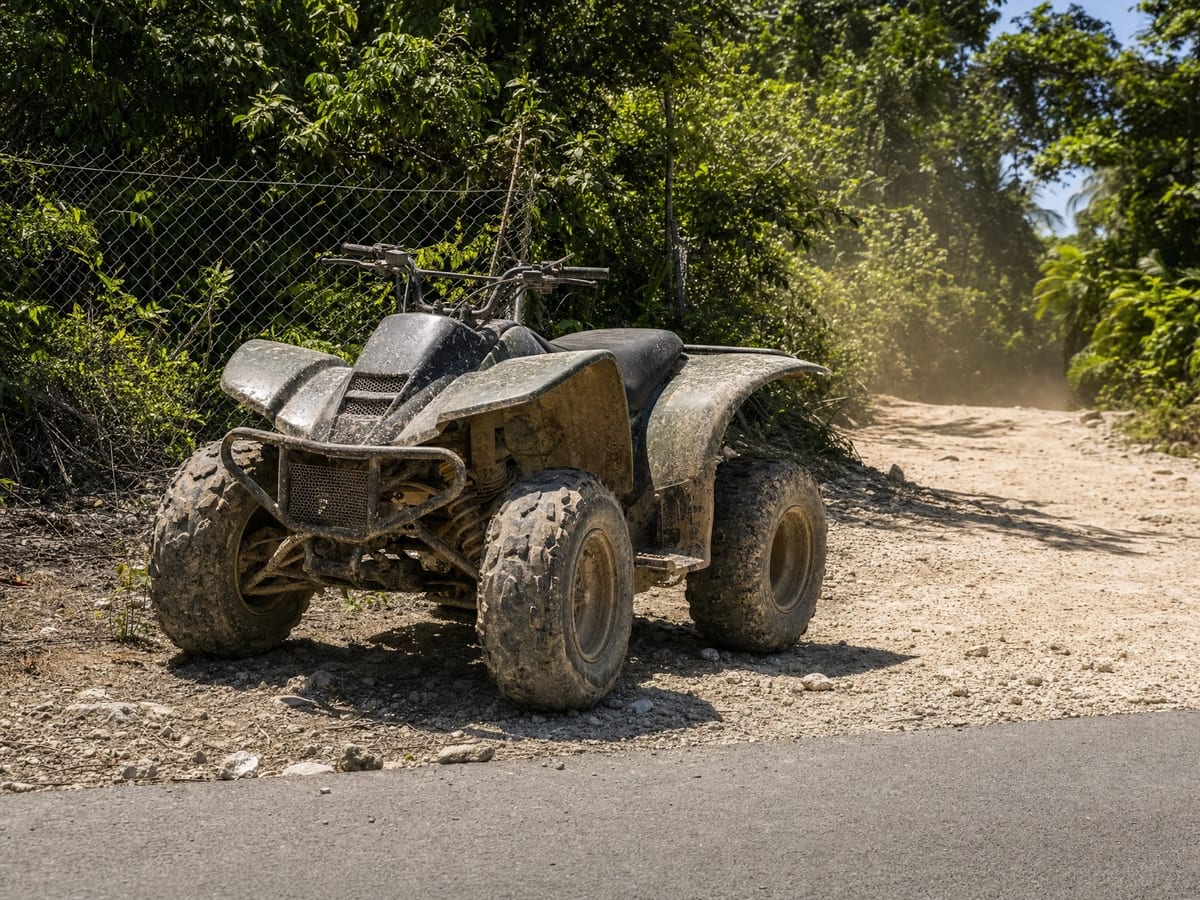
Search "ATV rental Tulum" or "quad bike Tulum" and you'll find offers. What you won't find is anyone quoting the rules — or saying plainly who carries the risk when something goes wrong. It isn't the shop. It's you, on the vehicle, at the roadside.
So we read them: Tulum's municipal traffic regulation, the Quintana Roo Mobility Law, and the state mobility institute's own permit paperwork. Every claim below is quoted and sourced at the end. We're a rental company that doesn't rent quads, so read it knowing exactly what we sell.
1. A quad has no legal category in Tulum
Tulum's traffic regulation defines a motorcycle in Article 4, section XVII:
"Motocicleta.- Vehículo motorizado de dos ruedas, con capacidad para una o dos personas."
A motorised vehicle of two wheels. Bicycles and tricycles are defined separately, both as human-powered (Art. 4, V and VI). And the chapter governing all of them — Chapter X, Article 63 — is titled "De la circulación de bicicletas, triciclos y motocicletas."
A four-wheeled petrol quad is none of those three. It fits no category the municipal rules recognise, while remaining a motor vehicle for every obligation that attaches to one.
The state-level definition closes the same door from the other side. The Ley de Movilidad del Estado de Quintana Roo, Article 4, section XLIV, defines a motorcycle as a handlebar-steered motor vehicle "con dos o más ruedas" — two or more wheels, which at first glance might seem to include a quad. But the same definition requires that it be:
"...inclinado por su conductor hacia el interior de una curva para contrarrestar la fuerza centrífuga."
Leaned by its rider into the curve to counteract centrifugal force.
That is the precise engineering difference between a motorcycle and an ATV. A quad does not lean — it's built on a rigid four-wheel stance, which is exactly why it behaves badly on tarmac. Under the state's own wording, a quad is not a motorcycle either.
What about buggies?
The same analysis applies to dune buggies and side-by-sides. They're off-road machines: no indicators, no mirrors, and no category in either instrument. A buggy that isn't plated, insured and covered by a permit is in precisely the position described below — and the fact that it has a roll cage and seat belts doesn't change its legal standing on a public road.
2. The equipment it's missing is the equipment the law requires
Article 44 opens:
"Todo conductor de vehículo de motor debe proveer lo necesario, a efecto de que el mismo cuente con..."
Every driver of a motor vehicle must ensure it has — among other things:
- Turn indicators, front and rear — "Direccionales de destello intermitente, delanteras y traseras" (Art. 44, III-e)
- At least two rear-view mirrors — "Al menos con dos espejos retrovisores" (Art. 44, VII)
A machine built for dunes and farm tracks isn't fitted with either. That isn't a detail you negotiate at a checkpoint — it's part of why the vehicle can't be plated for road use. Breach of Article 44 carries a fine of 8 days' minimum salary.
3. Helmets are mandatory, and the wording is unambiguous
Article 63, section IV:
"Usar casco. Los acompañantes también deben portarlo; se exceptúa de esto a los ciclistas."
Wear a helmet. Passengers must wear one too. Cyclists are the single exemption. It carries one of the heaviest penalties in the article — 12 days' minimum salary.
"It's a quad, not a motorbike" is not a defence. And note what that line also settles: helmets genuinely aren't legally required on bicycles and e-bikes here. We still recommend one, and ours are free.
4. What IMOVEQROO actually permits
Vehicle hire in Quintana Roo is regulated by the state mobility institute, IMOVEQROO, under the Mobility Law. Renting vehicles without a driver is a permitted service, and Article 90 Bis is blunt about the condition:
"El Servicio Público de Transporte de Micromovilidad solo podrá ser prestado si se cuenta con el permiso expedido por el Instituto."
It may only be provided by someone holding a permit from the Institute.
IMOVEQROO does issue permits covering all-terrain vehicles. They sit in a category called "otras modalidades", alongside horse-drawn calesas and cargo trikes, and the Institute publishes both the requirements and the fees.
But read what that permit requires the operator to file:
- a vehicle register listing plate numbers, engine and serial numbers
- a current insurance policy
- an enlarged copy of the valid tarjeta de circulación, plus photographs showing the plate front and rear
- an annual physical-mechanical inspection (revista vehicular)
- a register of drivers, each with their own driving licence number
That is the shape of a company operating plated, insured units with its own licensed drivers — a guided operation on suitable ground. It is not the shape of handing an unplated quad to a visitor and pointing them at town traffic.
The Mobility Law's two self-drive categories don't cover it either. Article 90 governs hire of automóviles — cars. Article 90 Bis governs micromovilidad, which Article 4, XLII defines as light personal vehicles, environmentally friendly, with "velocidades máximas de 50 kilómetros por hora" — and Article 4, LXXII lists them as bicycles, electric mopeds and small electric cars. A petrol quad is neither a car nor any of those.
So the accurate statement is not "ATVs are banned." It's narrower, and more useful to you: there is a permit route for all-terrain vehicles, and it is not a self-drive tourist hire route. If someone hands you keys and no plates, that's the side of the line you're standing on.
Three things people get wrong
"Everyone does it, so it must be fine."
A practice being visible isn't the same as it being covered. The permit, the plates and the policy either exist or they don't — and that only ever gets checked after something has happened.
"The rental insurance will cover me."
Insurance follows legal use of a legally registered vehicle. That's exactly why IMOVEQROO's own file demands plates and a live policy. On an unplated machine outside the permit, the shop's cover and your travel policy both have clean grounds to decline — most travel policies already exclude vehicles you weren't licensed or permitted to operate.
"Four wheels must be safer than two."
Quads are built for loose ground: tall, heavy, and not designed for sealed roads — which is why they aren't registered for them. On wet tarmac, in traffic, with no mirrors and no indicators, four wheels is not the safer choice.
What to rent instead
Everything people want a quad for, Tulum does better on something else — plated, insured, and usually cheaper.
| Licence needed | What it's for | |
|---|---|---|
| Scooter | Yes — a motorcycle licence. A car licence does not cover a scooter in Mexico | Cenotes, town, the beach road, longer trips. Insurance included every rental day, two helmets included |
| E-bike | No | Beach road and town without the effort, no paperwork |
| Bicycle | No | Short hops, the ruins, the cheapest way around |
Our scooters are road-legal and plated, insurance is included on every rental day, and two helmets come with each one. For licences, deposits and what's covered, see our guide to licences and police stops.
The short version
A quad bike has no category in Tulum's traffic rules, lacks the indicators and mirrors Article 44 requires of every motor vehicle, and helmets are mandatory under Article 63. IMOVEQROO does permit all-terrain vehicles — but through a framework built on plated, insured units and the operator's own licensed drivers, not self-drive hire. If a shop offers you one anyway, every part of that risk transfers to you the moment you ride away.
Rent something that's road-legal. You'll see more of Tulum on it.
We are a member of 1Tulum, a coalition of Tulum businesses held to one published standard — which includes telling you the hard parts, such as when the honest answer is "not from us".
Sources
- Reglamento de Tránsito para el Municipio de Tulum — Art. 4 (V, VI, XVII), Art. 44 (III-e, VII), Art. 63 (IV). Published in the Orden Jurídico Nacional: ordenjuridico.gob.mx
- Ley de Movilidad del Estado de Quintana Roo — Art. 4 (XLII, XLIV, LXXII), Art. 90, Art. 90 Bis. Last reform published in the Periódico Oficial, 24 July 2024: legismex.mty.itesm.mx
- IMOVEQROO — "Requisitos para solicitud de permiso de las otras modalidades" (calesas, vehículos todo terreno y vehículos de moto-carga): imoveqroo.qroo.gob.mx (archived copy — the institute’s own server is currently unreachable)
This article summarises regulations in force at the time of writing and is general information, not legal advice. Rules change — check with the authority or a professional before relying on it.
Questions people ask
- Can I rent an ATV in Tulum and drive it myself?
- Not on public roads. IMOVEQROO does have a permit route for “vehículos todo terreno”, but it is a commercial operator permit with a fleet register and named drivers — it is not a counter-hire route for visitors.
- Why are quads a problem on the road here?
- Most have no indicators and no rear-view mirrors, which is the basic equipment the traffic rules assume every vehicle has. They are also not permitted on the highway.
- Do I need a helmet on a quad?
- Yes. It is a motor vehicle, so the helmet requirement applies to the driver and anyone riding with them.
- What should I rent instead?
- For cenotes and real distance, a scooter — with a motorcycle licence. For town and the beach, a bicycle or an e-bike, which need no licence at all.